python
40 lines · 8 steps
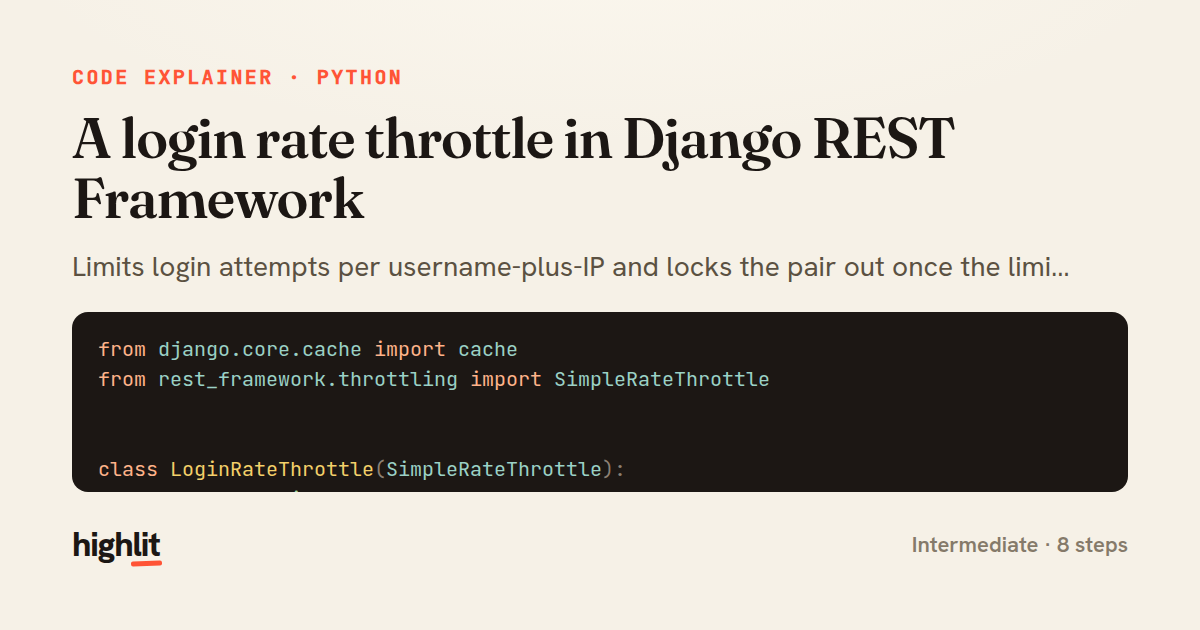
A login rate throttle in Django REST Framework
Limits login attempts per username-plus-IP and locks the pair out once the limit is hit.
Explained by
highlit
1from django.core.cache import cache
2from rest_framework.throttling import SimpleRateThrottle
3
4
5class LoginRateThrottle(SimpleRateThrottle):
6 scope = "login"
7
8 def get_cache_key(self, request, view):
9 username = (request.data.get("username") or "").strip().lower()
10 if not username:
11 return None
12 ident = self.get_ident(request)
13 return self.cache_format % {
14 "scope": self.scope,
15 "ident": f"{username}:{ident}",
16 }
17
18 def allow_request(self, request, view):
19 self.key = self.get_cache_key(request, view)
20 if self.key is None:
21 return True
22
23 if cache.get(f"{self.key}:locked"):
24 self.wait_time = cache.ttl(f"{self.key}:locked") or self.duration
25 return False
26
27 self.history = self.cache.get(self.key, [])
28 self.now = self.timer()
29 while self.history and self.history[-1] <= self.now - self.duration:
30 self.history.pop()
31
32 if len(self.history) >= self.num_requests:
33 cache.set(f"{self.key}:locked", True, timeout=self.duration)
34 self.wait_time = self.duration
35 return False
36
37 return self.throttle_success()
38
39 def wait(self):
40 return getattr(self, "wait_time", None) or super().wait()
01 / 01
STEP 01
‹ swipe to step through ›
Walkthrough
Space play
←→ step
click any line
Three takeaways
- 1Keying a throttle on username-plus-IP targets brute-force attempts without blocking whole networks.
- 2A short-lived lock flag in the cache turns a soft rate limit into a hard cooldown once tripped.
- 3Returning None from the cache key cleanly opts a request out of throttling entirely.
Related explainers
python
from fastapi import FastAPI, WebSocket, WebSocketDisconnect

app = FastAPI()
Building a WebSocket chat with FastAPI
websockets
broadcast
connection-management
Intermediate
9 steps
python
import time
import uuid

from django.utils.deprecation import MiddlewareMixin
Attaching per-request context in Django
middleware
request lifecycle
multi-tenancy
Intermediate
7 steps
javascript
import { useState, useEffect, useCallback, useRef } from 'react';

const cache = new Map();
const inflight = new Map();
Building a stale-while-revalidate hook in React
caching
request-deduplication
custom-hooks
Advanced
10 steps
python
import random
from typing import Iterator, List
How reservoir sampling picks k items
reservoir-sampling
streaming
randomness
Intermediate
5 steps
php
<?php

namespace App\Services;
Building a cached daily leaderboard in Laravel
caching
aggregation
eager-loading
Intermediate
9 steps
python
import secrets

from django.contrib.auth import authenticate, login
from django.core.cache import cache
Two-factor login with OTP in Django
two-factor-auth
one-time-passwords
caching
Intermediate
9 steps
Share this explainer
Here's the card — post it anywhere.
Made with highlit — turn any snippet into a walkthrough like this in about a minute.
Explain your code
Embed this explainer
Drop the interactive walkthrough into a blog or docs. Views never cost a credit.
<iframe src="https://highlit.co/explainers/a-login-rate-throttle-in-django-rest-framework-explained-python-ec0c/embed?autoplay=1" width="100%" height="520" loading="lazy" style="border:0"></iframe>
Autoplay is on by default — add ?autoplay=0 to start paused.