go
64 lines · 9 steps
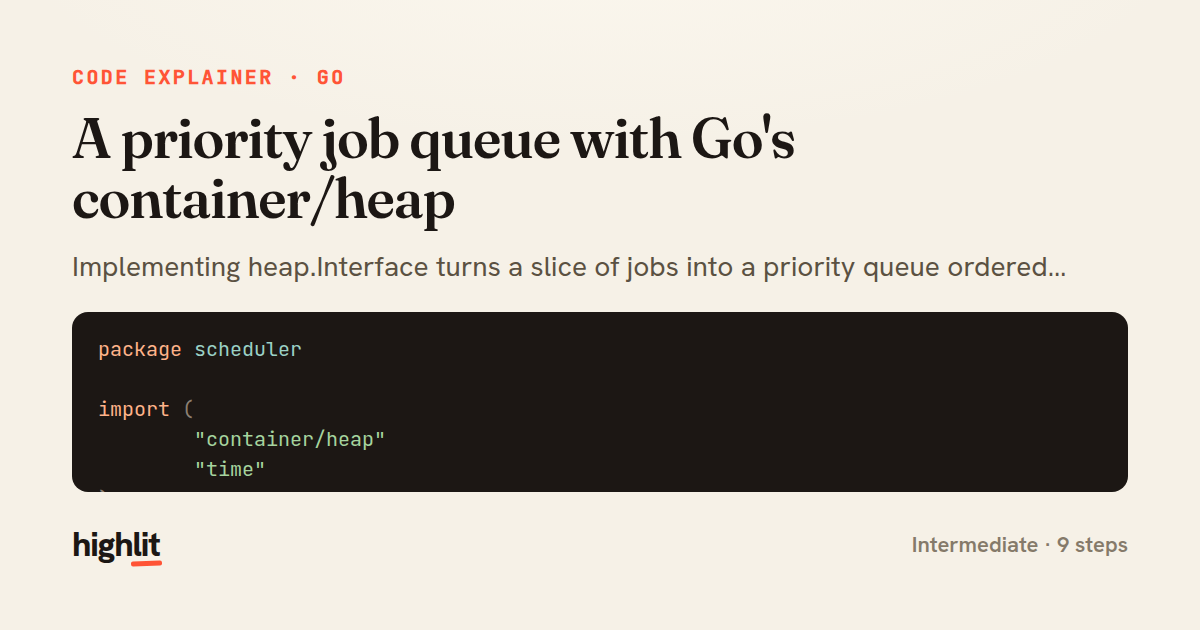
A priority job queue with Go's container/heap
Implementing heap.Interface turns a slice of jobs into a priority queue ordered by priority then arrival time.
Explained by
highlit
1package scheduler
2
3import (
4 "container/heap"
5 "time"
6)
7
8type Job struct {
9 ID string
10 Priority int
11 Enqueued time.Time
12 Payload []byte
13 index int
14}
15
16type JobQueue []*Job
17
18func (q JobQueue) Len() int { return len(q) }
19
20func (q JobQueue) Less(i, j int) bool {
21 if q[i].Priority != q[j].Priority {
22 return q[i].Priority > q[j].Priority
23 }
24 return q[i].Enqueued.Before(q[j].Enqueued)
25}
26
27func (q JobQueue) Swap(i, j int) {
28 q[i], q[j] = q[j], q[i]
29 q[i].index = i
30 q[j].index = j
31}
32
33func (q *JobQueue) Push(x any) {
34 job := x.(*Job)
35 job.index = len(*q)
36 *q = append(*q, job)
37}
38
39func (q *JobQueue) Pop() any {
40 old := *q
41 n := len(old)
42 job := old[n-1]
43 old[n-1] = nil
44 job.index = -1
45 *q = old[:n-1]
46 return job
47}
48
49func (q *JobQueue) Enqueue(job *Job) {
50 job.Enqueued = time.Now()
51 heap.Push(q, job)
52}
53
54func (q *JobQueue) Dequeue() (*Job, bool) {
55 if q.Len() == 0 {
56 return nil, false
57 }
58 return heap.Pop(q).(*Job), true
59}
60
61func (q *JobQueue) Reprioritize(job *Job, priority int) {
62 job.Priority = priority
63 heap.Fix(q, job.index)
64}
01 / 01
STEP 01
‹ swipe to step through ›
Walkthrough
Space play
←→ step
click any line
Three takeaways
- 1Satisfying heap.Interface lets the standard library manage ordering while you own the storage.
- 2A tie-breaker in Less gives you stable, fair ordering — here oldest job wins on equal priority.
- 3Tracking each element's index enables O(log n) removal and reprioritization, not just push and pop.
Related explainers
go
package streaming

import (
	"bufio"
Streaming NDJSON logs over HTTP in Go
http-streaming
channels
select
Advanced
10 steps
go
package api

import (
	"crypto/sha256"
ETag conditional requests in Gin
http-caching
etag
conditional-requests
Intermediate
6 steps
go
func (w *Watcher) resetDebounce(d time.Duration) {
	if !w.timer.Stop() {
		select {
		case <-w.timer.C:
Debouncing a stream of events in Go
debounce
timers
channels
Advanced
7 steps
go
package logging

import (
	"context"
Deduplicating log attributes in Go's slog
decorator-pattern
structured-logging
immutability
Intermediate
8 steps
go
package middleware

import (
	"net/http"
Per-plan export limits in Gin middleware
middleware
rate-limiting
authorization
Intermediate
7 steps
go
package httputil

import (
	"net"
Safely extracting the real client IP in Go
security
http
ip-spoofing
Intermediate
7 steps
Share this explainer
Here's the card — post it anywhere.
Made with highlit — turn any snippet into a walkthrough like this in about a minute.
Explain your code
Embed this explainer
Drop the interactive walkthrough into a blog or docs. Views never cost a credit.
<iframe src="https://highlit.co/explainers/a-priority-job-queue-with-go-s-container-heap-explained-go-1182/embed?autoplay=1" width="100%" height="520" loading="lazy" style="border:0"></iframe>
Autoplay is on by default — add ?autoplay=0 to start paused.