go
42 lines · 7 steps
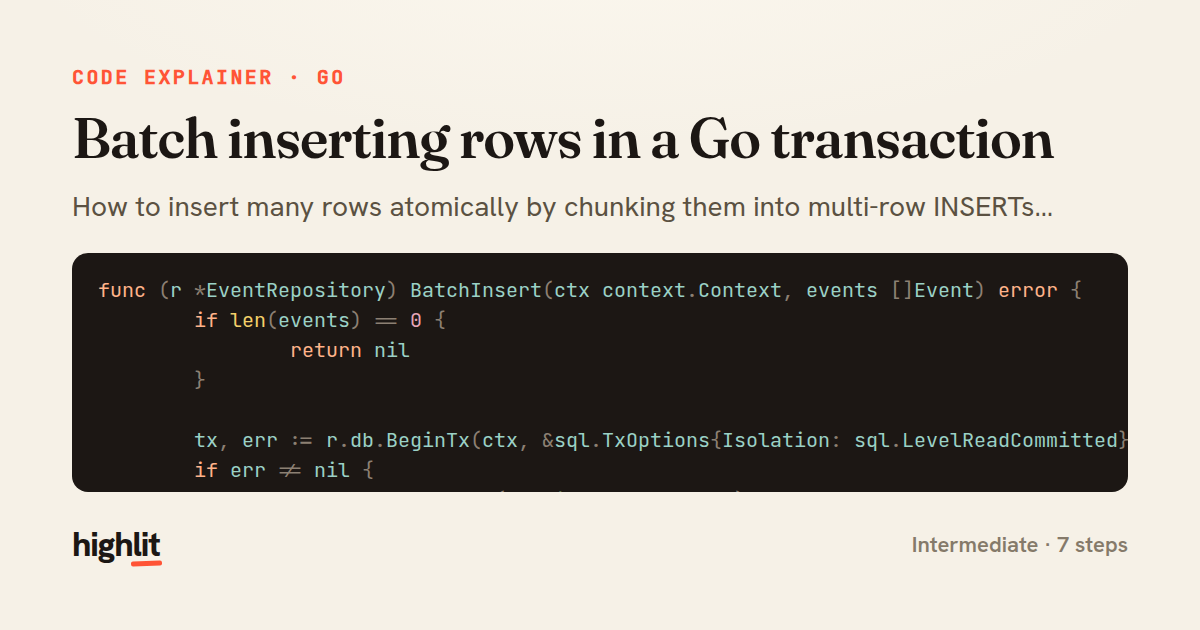
Batch inserting rows in a Go transaction
How to insert many rows atomically by chunking them into multi-row INSERTs inside one transaction.
Explained by
highlit
1func (r *EventRepository) BatchInsert(ctx context.Context, events []Event) error {
2 if len(events) == 0 {
3 return nil
4 }
5
6 tx, err := r.db.BeginTx(ctx, &sql.TxOptions{Isolation: sql.LevelReadCommitted})
7 if err != nil {
8 return fmt.Errorf("begin tx: %w", err)
9 }
10 defer tx.Rollback()
11
12 const batchSize = 500
13 for start := 0; start < len(events); start += batchSize {
14 end := start + batchSize
15 if end > len(events) {
16 end = len(events)
17 }
18 chunk := events[start:end]
19
20 values := make([]string, 0, len(chunk))
21 args := make([]interface{}, 0, len(chunk)*4)
22 for i, e := range chunk {
23 n := i * 4
24 values = append(values, fmt.Sprintf("($%d, $%d, $%d, $%d)", n+1, n+2, n+3, n+4))
25 args = append(args, e.AggregateID, e.Type, e.Payload, e.OccurredAt)
26 }
27
28 query := fmt.Sprintf(
29 "INSERT INTO events (aggregate_id, type, payload, occurred_at) VALUES %s",
30 strings.Join(values, ", "),
31 )
32
33 if _, err := tx.ExecContext(ctx, query, args...); err != nil {
34 return fmt.Errorf("insert batch [%d:%d]: %w", start, end, err)
35 }
36 }
37
38 if err := tx.Commit(); err != nil {
39 return fmt.Errorf("commit tx: %w", err)
40 }
41 return nil
42}
01 / 01
STEP 01
‹ swipe to step through ›
Walkthrough
Space play
←→ step
click any line
Three takeaways
- 1Chunking large inserts caps how many parameters land in any single query, avoiding placeholder and packet limits.
- 2A deferred rollback plus an explicit commit guarantees all-or-nothing writes even when a batch fails midway.
- 3Building placeholders and args in lockstep keeps positional parameters aligned and safe from injection.
Related explainers
rust
use serde::Deserialize;

#[derive(Debug, Deserialize)]
#[serde(untagged)]
Parsing flexible JSON shapes with serde
deserialization
enums
json
Intermediate
6 steps
ruby
require "shellwords"
require "open3"

module Backup
Building safe shell commands in Ruby
shell-out
subprocess
command-injection
Intermediate
7 steps
go
package streaming

import (
	"bufio"
Streaming NDJSON logs over HTTP in Go
http-streaming
channels
select
Advanced
10 steps
php
<?php

namespace App\Services\Checkout;
Validating coupons with Laravel's Pipeline
pipeline
chain of responsibility
transactions
Intermediate
7 steps
go
package api

import (
	"crypto/sha256"
ETag conditional requests in Gin
http-caching
etag
conditional-requests
Intermediate
6 steps
go
func (w *Watcher) resetDebounce(d time.Duration) {
	if !w.timer.Stop() {
		select {
		case <-w.timer.C:
Debouncing a stream of events in Go
debounce
timers
channels
Advanced
7 steps
Share this explainer
Here's the card — post it anywhere.
Made with highlit — turn any snippet into a walkthrough like this in about a minute.
Explain your code
Embed this explainer
Drop the interactive walkthrough into a blog or docs. Views never cost a credit.
<iframe src="https://highlit.co/explainers/batch-inserting-rows-in-a-go-transaction-explained-go-f251/embed?autoplay=1" width="100%" height="520" loading="lazy" style="border:0"></iframe>
Autoplay is on by default — add ?autoplay=0 to start paused.