python
37 lines · 8 steps
Building a typed descriptor in Python
A data descriptor that enforces types and runs custom validators on every attribute assignment.
Explained by
highlit
1class Typed:
2 """A data descriptor that enforces a type and optional validation."""
3
4 def __init__(self, expected_type, validator=None):
5 self.expected_type = expected_type
6 self.validator = validator
7
8 def __set_name__(self, owner, name):
9 self.name = name
10 self.private_name = f"_{name}"
11
12 def __get__(self, instance, owner=None):
13 if instance is None:
14 return self
15 return getattr(instance, self.private_name)
16
17 def __set__(self, instance, value):
18 if not isinstance(value, self.expected_type):
19 raise TypeError(
20 f"{self.name!r} must be {self.expected_type.__name__}, "
21 f"got {type(value).__name__}"
22 )
23 if self.validator is not None and not self.validator(value):
24 raise ValueError(f"{value!r} failed validation for {self.name!r}")
25 setattr(instance, self.private_name, value)
26
27 def __delete__(self, instance):
28 raise AttributeError(f"{self.name!r} cannot be deleted")
29
30
31class Account:
32 owner = Typed(str, validator=lambda s: len(s) > 0)
33 balance = Typed((int, float), validator=lambda n: n >= 0)
34
35 def __init__(self, owner, balance):
36 self.owner = owner
37 self.balance = balance
01 / 01
STEP 01
‹ swipe to step through ›
Walkthrough
Space play
←→ step
click any line
Three takeaways
- 1Data descriptors intercept attribute access at the class level, letting you centralize validation logic instead of scattering checks across setters.
- 2__set_name__ hands each descriptor its own attribute name automatically, so one descriptor class can be reused for many fields.
- 3Storing values under a per-name private attribute keeps the descriptor's bookkeeping separate from the public attribute it guards.
Related explainers
python
from fastapi import FastAPI, WebSocket, WebSocketDisconnect

app = FastAPI()
Building a WebSocket chat with FastAPI
websockets
broadcast
connection-management
Intermediate
9 steps
php
<?php

namespace App\Services\Checkout;
Validating coupons with Laravel's Pipeline
pipeline
chain of responsibility
transactions
Intermediate
7 steps
python
import time
import uuid

from django.utils.deprecation import MiddlewareMixin
Attaching per-request context in Django
middleware
request lifecycle
multi-tenancy
Intermediate
7 steps
php
<?php

namespace App\Services;
How a password strength validator works in PHP
validation
regular-expressions
data-driven
Intermediate
8 steps
python
import random
from typing import Iterator, List
How reservoir sampling picks k items
reservoir-sampling
streaming
randomness
Intermediate
5 steps
rust
use chrono::{Duration, NaiveDate};

#[derive(Debug)]
pub struct DateRange {
Parsing and iterating date ranges in Rust
error-handling
iterators
parsing
Intermediate
7 steps
Share this explainer
Here's the card — post it anywhere.
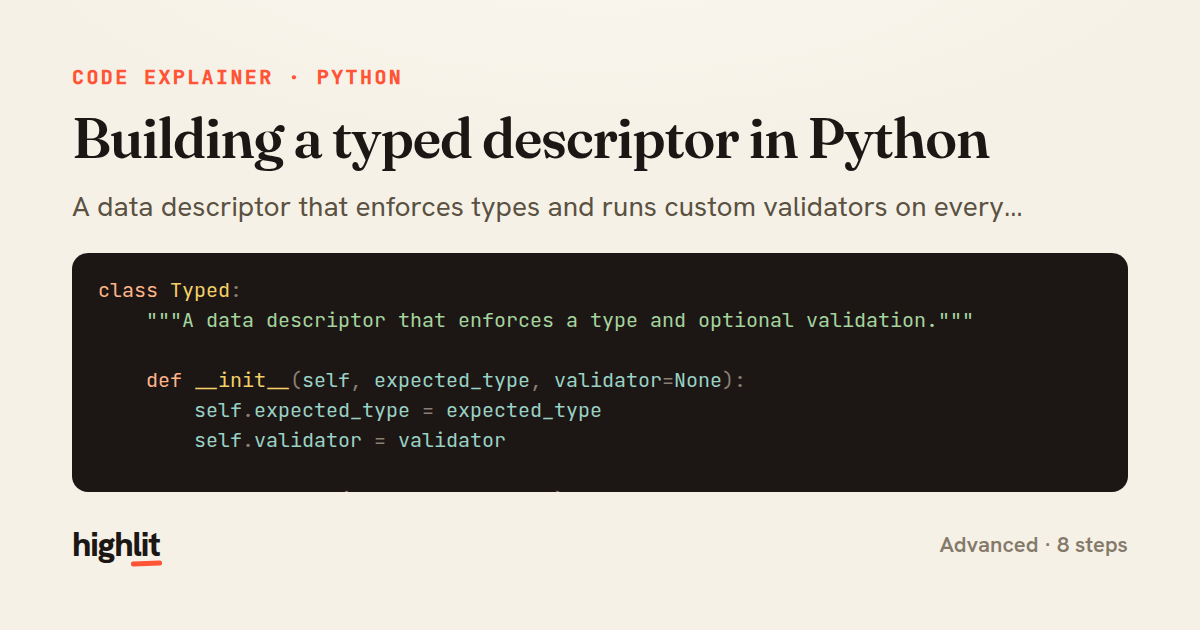
Made with highlit — turn any snippet into a walkthrough like this in about a minute.
Explain your code
Embed this explainer
Drop the interactive walkthrough into a blog or docs. Views never cost a credit.
<iframe src="https://highlit.co/explainers/building-a-typed-descriptor-in-python-explained-python-61cb/embed?autoplay=1" width="100%" height="520" loading="lazy" style="border:0"></iframe>
Autoplay is on by default — add ?autoplay=0 to start paused.