ruby
33 lines · 6 steps
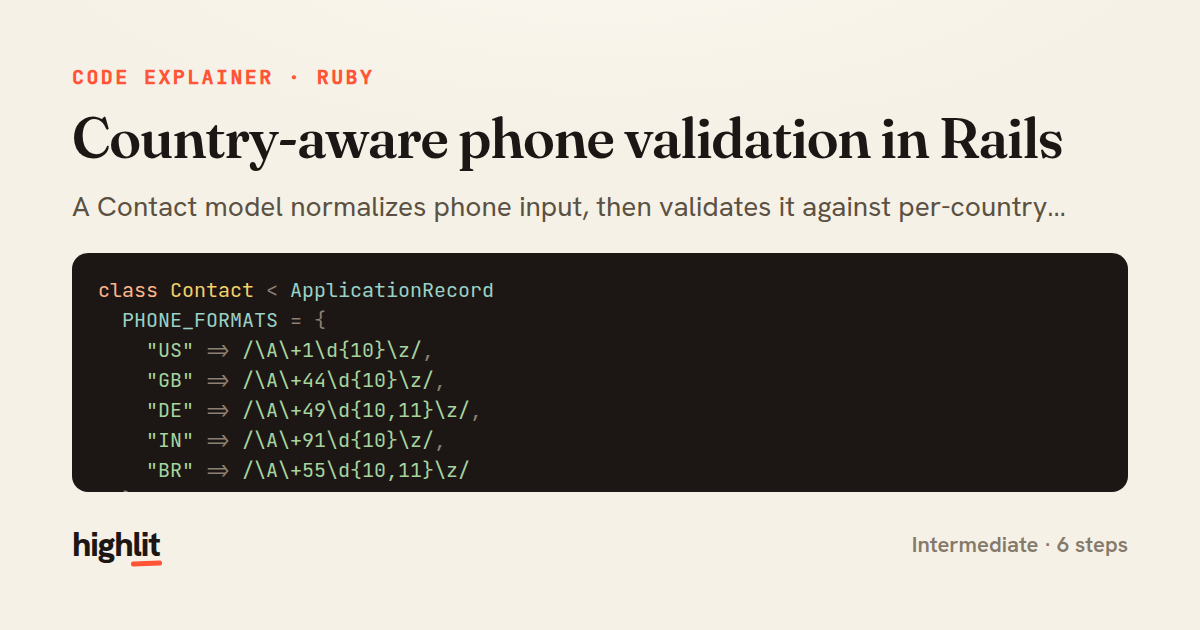
Country-aware phone validation in Rails
A Contact model normalizes phone input, then validates it against per-country regex rules with tailored error messages.
Explained by
highlit
1class Contact < ApplicationRecord
2 PHONE_FORMATS = {
3 "US" => /\A\+1\d{10}\z/,
4 "GB" => /\A\+44\d{10}\z/,
5 "DE" => /\A\+49\d{10,11}\z/,
6 "IN" => /\A\+91\d{10}\z/,
7 "BR" => /\A\+55\d{10,11}\z/
8 }.freeze
9
10 before_validation :normalize_phone
11
12 validates_each :phone do |record, attr, value|
13 country = record.country_code.to_s.upcase
14 format = PHONE_FORMATS[country]
15
16 if value.blank?
17 record.errors.add(attr, :blank)
18 elsif format.nil?
19 record.errors.add(attr, :unsupported_country, country: country)
20 elsif !value.match?(format)
21 record.errors.add(attr, :invalid_phone, country: country)
22 end
23 end
24
25 private
26
27 def normalize_phone
28 return if phone.blank?
29
30 digits = phone.gsub(/[\s().-]/, "")
31 self.phone = digits.start_with?("+") ? digits : "+#{digits}"
32 end
33end
01 / 01
STEP 01
‹ swipe to step through ›
Walkthrough
Space play
←→ step
click any line
Three takeaways
- 1Normalizing input in a before_validation callback lets validation logic assume clean, canonical data.
- 2A lookup table of regexes keyed by identifier keeps per-case rules declarative and easy to extend.
- 3Distinct error keys let each failure mode produce its own translatable, context-rich message.
Related explainers
ruby
require "shellwords"
require "open3"

module Backup
Building safe shell commands in Ruby
shell-out
subprocess
command-injection
Intermediate
7 steps
php
<?php

namespace App\Services\Checkout;
Validating coupons with Laravel's Pipeline
pipeline
chain of responsibility
transactions
Intermediate
7 steps
ruby
class UserAgentParser
  BROWSERS = [
    [/Edg\/([\d.]+)/, "Edge"],
    [/OPR\/([\d.]+)/, "Opera"],
Parsing user-agent strings in Ruby
regex
pattern-matching
lookup-tables
Intermediate
8 steps
php
<?php

namespace App\Services;
How a password strength validator works in PHP
validation
regular-expressions
data-driven
Intermediate
8 steps
ruby
class LogAggregator
  BUCKET_FORMAT = "%Y-%m-%dT%H:%M"

  def initialize(entries)
Bucketing log entries by the minute in Ruby
aggregation
hashing
enumerable
Intermediate
5 steps
ruby
class WeeklySignupsReport
  DEFAULT_WEEKS = 12

  def initialize(weeks: DEFAULT_WEEKS, source: User.all)
Building a weekly signups report in Rails
service object
aggregation
group by
Intermediate
7 steps
Share this explainer
Here's the card — post it anywhere.
Made with highlit — turn any snippet into a walkthrough like this in about a minute.
Explain your code
Embed this explainer
Drop the interactive walkthrough into a blog or docs. Views never cost a credit.
<iframe src="https://highlit.co/explainers/country-aware-phone-validation-in-rails-explained-ruby-534a/embed?autoplay=1" width="100%" height="520" loading="lazy" style="border:0"></iframe>
Autoplay is on by default — add ?autoplay=0 to start paused.