ruby
35 lines · 7 steps
Currying lambdas and methods in Ruby
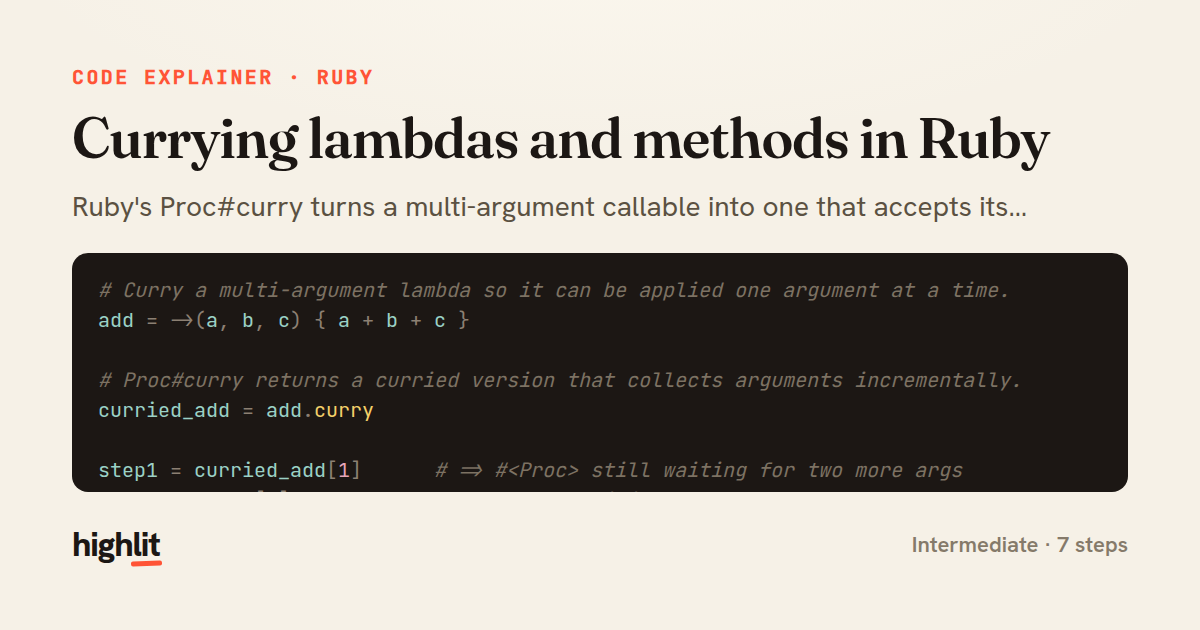
Ruby's Proc#curry turns a multi-argument callable into one that accepts its arguments one at a time.
Explained by
highlit
1# Curry a multi-argument lambda so it can be applied one argument at a time.
2add = ->(a, b, c) { a + b + c }
3
4# Proc#curry returns a curried version that collects arguments incrementally.
5curried_add = add.curry
6
7step1 = curried_add[1] # => #<Proc> still waiting for two more args
8step2 = step1[2] # => #<Proc> waiting for one more arg
9result = step2[3] # => 6, fully applied
10
11# You can also supply several arguments at once.
12curried_add[1][2, 3] # => 6
13curried_add[1, 2, 3] # => 6
14
15# Methods become curryable by first converting them to a Proc.
16class Discounter
17 def apply(rate, base_price)
18 base_price - (base_price * rate)
19 end
20end
21
22discounter = Discounter.new
23discount = discounter.method(:apply).to_proc.curry
24
25# Build specialized functions by partially applying the first argument.
26ten_percent_off = discount[0.10]
27half_off = discount[0.50]
28
29ten_percent_off[100] # => 90.0
30half_off[100] # => 50.0
31
32# curry(arity) lets you fix how many arguments to expect for variadic procs.
33join = ->(*parts) { parts.join('/') }
34path = join.curry(3)
35full = path['usr']['local']['bin'] # => "usr/local/bin"
01 / 01
STEP 01
‹ swipe to step through ›
Walkthrough
Space play
←→ step
click any line
Three takeaways
- 1Currying lets you fix some arguments now and supply the rest later, building specialized functions from general ones.
- 2A curried proc returns either another proc (when under-applied) or the final result (when fully applied), so you can chain calls flexibly.
- 3Methods aren't procs, but method(:name).to_proc bridges the gap so any method can be curried too.
Related explainers
ruby
require "shellwords"
require "open3"

module Backup
Building safe shell commands in Ruby
shell-out
subprocess
command-injection
Intermediate
7 steps
ruby
class UserAgentParser
  BROWSERS = [
    [/Edg\/([\d.]+)/, "Edge"],
    [/OPR\/([\d.]+)/, "Opera"],
Parsing user-agent strings in Ruby
regex
pattern-matching
lookup-tables
Intermediate
8 steps
javascript
function evaluate(expression) {
  const tokens = tokenize(expression);
  let pos = 0;
Building a recursive descent calculator
parsing
recursion
operator-precedence
Intermediate
8 steps
php
<?php

namespace App\Services;
How a password strength validator works in PHP
validation
regular-expressions
data-driven
Intermediate
8 steps
ruby
class LogAggregator
  BUCKET_FORMAT = "%Y-%m-%dT%H:%M"

  def initialize(entries)
Bucketing log entries by the minute in Ruby
aggregation
hashing
enumerable
Intermediate
5 steps
ruby
class WeeklySignupsReport
  DEFAULT_WEEKS = 12

  def initialize(weeks: DEFAULT_WEEKS, source: User.all)
Building a weekly signups report in Rails
service object
aggregation
group by
Intermediate
7 steps
Share this explainer
Here's the card — post it anywhere.
Made with highlit — turn any snippet into a walkthrough like this in about a minute.
Explain your code
Embed this explainer
Drop the interactive walkthrough into a blog or docs. Views never cost a credit.
<iframe src="https://highlit.co/explainers/currying-lambdas-and-methods-in-ruby-explained-ruby-315f/embed?autoplay=1" width="100%" height="520" loading="lazy" style="border:0"></iframe>
Autoplay is on by default — add ?autoplay=0 to start paused.