ruby
51 lines · 8 steps
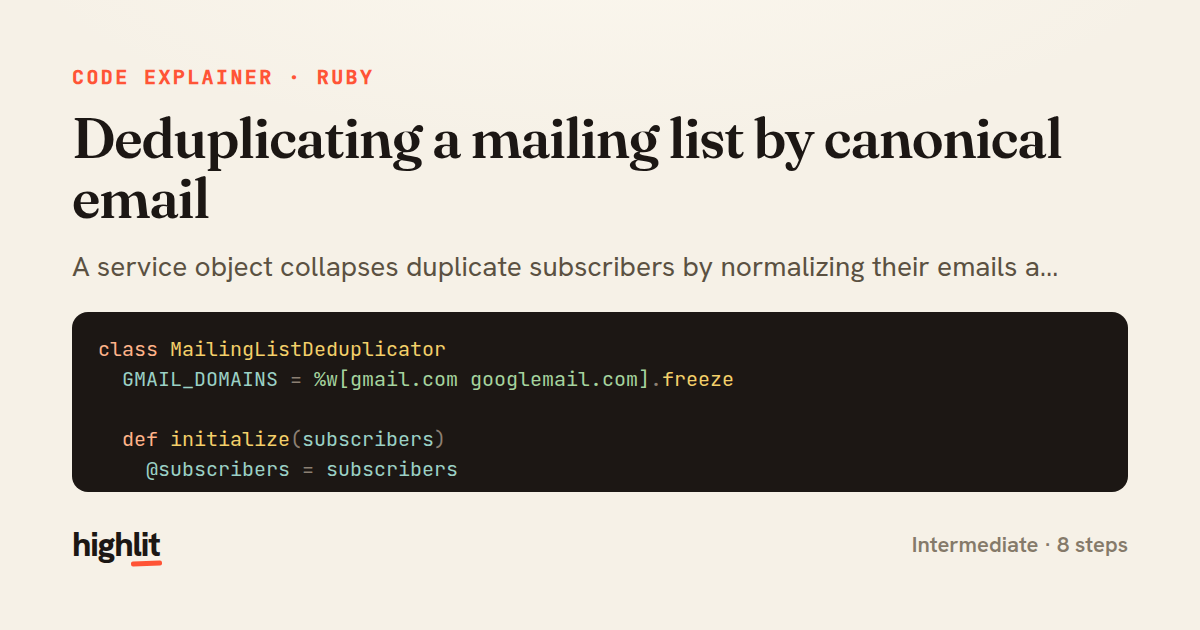
Deduplicating a mailing list by canonical email
A service object collapses duplicate subscribers by normalizing their emails and keeping only the most recent entry per address.
Explained by
highlit
1class MailingListDeduplicator
2 GMAIL_DOMAINS = %w[gmail.com googlemail.com].freeze
3
4 def initialize(subscribers)
5 @subscribers = subscribers
6 end
7
8 def call
9 seen = {}
10
11 @subscribers.each do |subscriber|
12 key = normalize(subscriber.fetch(:email))
13 next if key.nil?
14
15 existing = seen[key]
16 if existing.nil? || newer?(subscriber, existing)
17 seen[key] = subscriber
18 end
19 end
20
21 seen.values
22 end
23
24 private
25
26 def normalize(raw)
27 return nil if raw.nil?
28
29 address = raw.strip.downcase
30 local, domain = address.split("@", 2)
31 return nil if local.nil? || domain.nil? || local.empty? || domain.empty?
32
33 local = local.split("+", 2).first
34
35 if GMAIL_DOMAINS.include?(domain)
36 local = local.delete(".")
37 domain = "gmail.com"
38 end
39
40 "#{local}@#{domain}"
41 end
42
43 def newer?(candidate, existing)
44 candidate_at = candidate[:subscribed_at]
45 existing_at = existing[:subscribed_at]
46 return false if candidate_at.nil?
47 return true if existing_at.nil?
48
49 candidate_at > existing_at
50 end
51end
01 / 01
STEP 01
‹ swipe to step through ›
Walkthrough
Space play
←→ step
click any line
Three takeaways
- 1Normalizing keys before comparison lets you treat semantically-equal values as identical.
- 2Keeping a hash of seen keys turns deduplication into a single linear pass.
- 3Encoding domain-specific rules like Gmail's dot and plus aliases makes matching match real-world identity.
Related explainers
php
<?php

class NameParser
{
Parsing a full name into components in PHP
string-parsing
arrays
normalization
Intermediate
8 steps
ruby
require "shellwords"
require "open3"

module Backup
Building safe shell commands in Ruby
shell-out
subprocess
command-injection
Intermediate
7 steps
ruby
class UserAgentParser
  BROWSERS = [
    [/Edg\/([\d.]+)/, "Edge"],
    [/OPR\/([\d.]+)/, "Opera"],
Parsing user-agent strings in Ruby
regex
pattern-matching
lookup-tables
Intermediate
8 steps
ruby
class LogAggregator
  BUCKET_FORMAT = "%Y-%m-%dT%H:%M"

  def initialize(entries)
Bucketing log entries by the minute in Ruby
aggregation
hashing
enumerable
Intermediate
5 steps
ruby
class WeeklySignupsReport
  DEFAULT_WEEKS = 12

  def initialize(weeks: DEFAULT_WEEKS, source: User.all)
Building a weekly signups report in Rails
service object
aggregation
group by
Intermediate
7 steps
go
package logging

import (
	"context"
Deduplicating log attributes in Go's slog
decorator-pattern
structured-logging
immutability
Intermediate
8 steps
Share this explainer
Here's the card — post it anywhere.
Made with highlit — turn any snippet into a walkthrough like this in about a minute.
Explain your code
Embed this explainer
Drop the interactive walkthrough into a blog or docs. Views never cost a credit.
<iframe src="https://highlit.co/explainers/deduplicating-a-mailing-list-by-canonical-email-explained-ruby-2ead/embed?autoplay=1" width="100%" height="520" loading="lazy" style="border:0"></iframe>
Autoplay is on by default — add ?autoplay=0 to start paused.