ruby
45 lines · 7 steps
Deduplicating uploads by content hash
A service that fingerprints each upload with SHA-256 and reuses an existing record when the bytes already exist.
Explained by
highlit
1require "digest"
2
3class UploadDeduplicator
4 CHUNK_SIZE = 64 * 1024
5
6 def initialize(store: UploadDigest)
7 @store = store
8 end
9
10 def register(upload)
11 digest = compute_digest(upload.tempfile.path)
12
13 existing = @store.find_by(sha256: digest)
14 if existing
15 return DuplicateResult.new(duplicate: true, canonical: existing, digest: digest)
16 end
17
18 record = @store.create!(
19 sha256: digest,
20 byte_size: upload.size,
21 content_type: upload.content_type,
22 original_filename: upload.original_filename
23 )
24
25 DuplicateResult.new(duplicate: false, canonical: record, digest: digest)
26 end
27
28 private
29
30 def compute_digest(path)
31 sha = Digest::SHA256.new
32 File.open(path, "rb") do |io|
33 while (chunk = io.read(CHUNK_SIZE))
34 sha.update(chunk)
35 end
36 end
37 sha.hexdigest
38 end
39
40 DuplicateResult = Struct.new(:duplicate, :canonical, :digest, keyword_init: true) do
41 def duplicate?
42 duplicate
43 end
44 end
45end
01 / 01
STEP 01
‹ swipe to step through ›
Walkthrough
Space play
←→ step
click any line
Three takeaways
- 1Content-addressing by cryptographic hash lets you detect identical files regardless of their names or metadata.
- 2Reading a file in fixed-size chunks keeps memory flat no matter how large the upload is.
- 3Injecting the store dependency and returning a small value object keeps the class easy to test and its result explicit.
Related explainers
typescript
import { registerLocaleData } from '@angular/common';
import localeFr from '@angular/common/locales/fr';
import localeFrExtra from '@angular/common/locales/extra/fr';
import localeDe from '@angular/common/locales/de';
Locale-aware bootstrapping in Angular
i18n
localization
dependency-injection
Intermediate
8 steps
ruby
require "shellwords"
require "open3"

module Backup
Building safe shell commands in Ruby
shell-out
subprocess
command-injection
Intermediate
7 steps
typescript
import { Module } from '@nestjs/common';
import { ConfigModule } from '@nestjs/config';
import * as Joi from 'joi';
Validating env config at boot in NestJS
configuration
schema-validation
environment-variables
Intermediate
8 steps
rust
use std::cmp::{Ordering, Reverse};
use std::collections::BinaryHeap;
use std::fs::File;
use std::io::{self, BufRead, BufReader, BufWriter, Lines, Write};
K-way merge of sorted logs in Rust
binary-heap
k-way-merge
streaming-io
Intermediate
8 steps
ruby
class UserAgentParser
  BROWSERS = [
    [/Edg\/([\d.]+)/, "Edge"],
    [/OPR\/([\d.]+)/, "Opera"],
Parsing user-agent strings in Ruby
regex
pattern-matching
lookup-tables
Intermediate
8 steps
java
@Component
@Converter
public class EncryptedStringConverter implements AttributeConverter<String, String> {
Transparent column encryption in Spring & JPA
encryption
aes-gcm
jpa-converter
Advanced
10 steps
Share this explainer
Here's the card — post it anywhere.
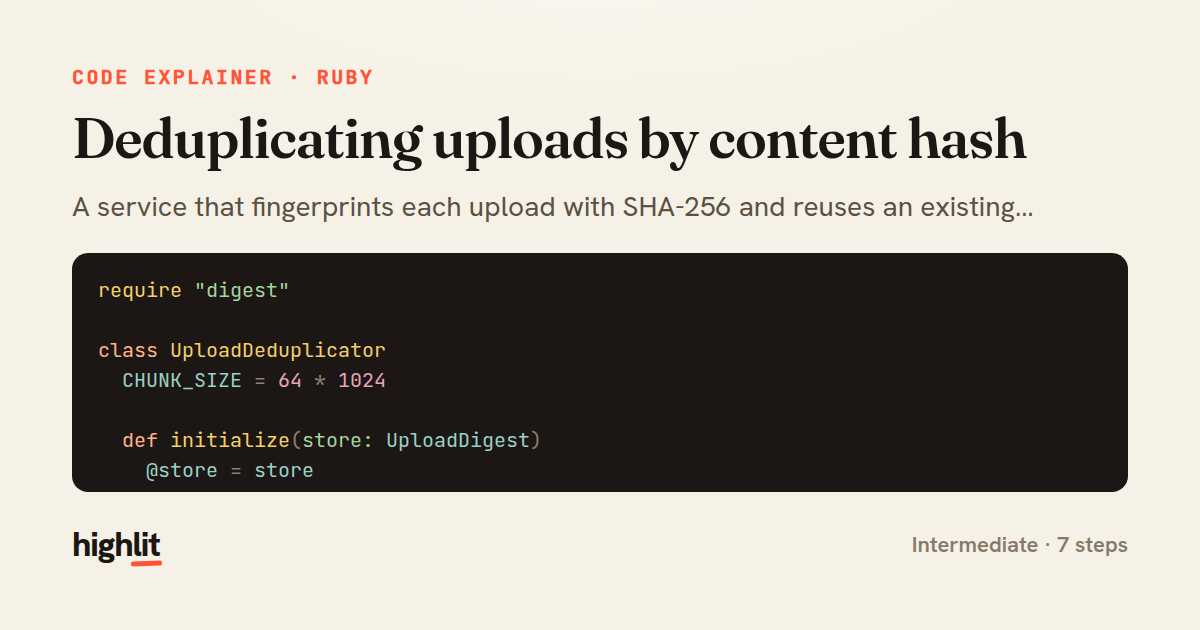
Made with highlit — turn any snippet into a walkthrough like this in about a minute.
Explain your code
Embed this explainer
Drop the interactive walkthrough into a blog or docs. Views never cost a credit.
<iframe src="https://highlit.co/explainers/deduplicating-uploads-by-content-hash-explained-ruby-0350/embed?autoplay=1" width="100%" height="520" loading="lazy" style="border:0"></iframe>
Autoplay is on by default — add ?autoplay=0 to start paused.