javascript
35 lines · 7 steps
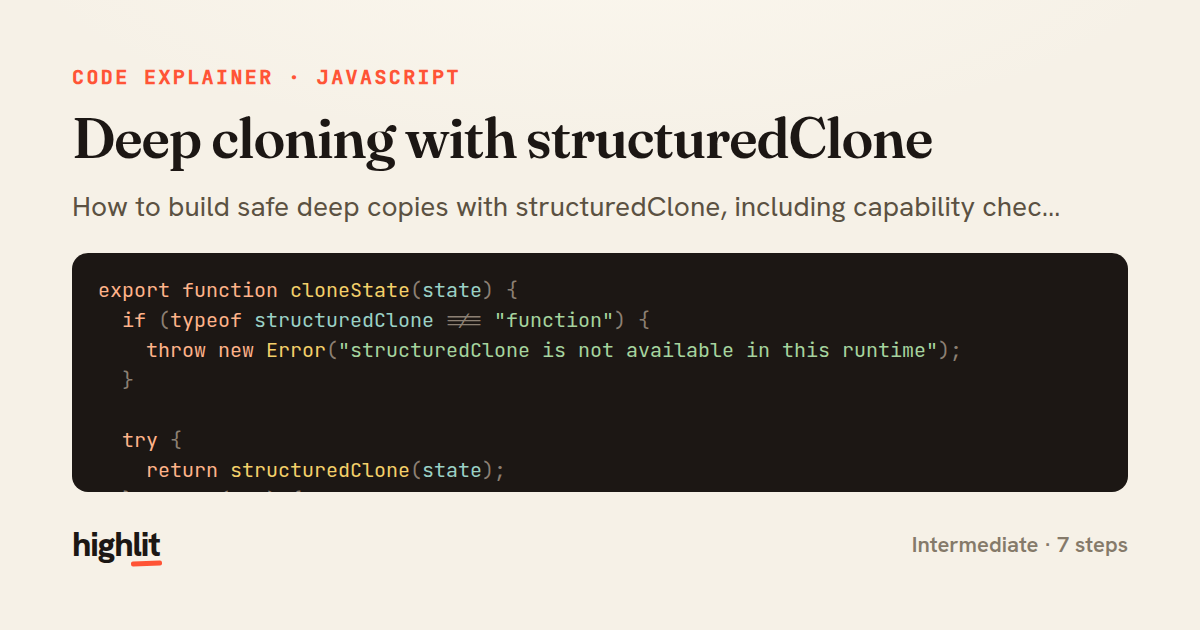
Deep cloning with structuredClone
How to build safe deep copies with structuredClone, including capability checks and cloner-aware error handling.
Explained by
highlit
1export function cloneState(state) {
2 if (typeof structuredClone !== "function") {
3 throw new Error("structuredClone is not available in this runtime");
4 }
5
6 try {
7 return structuredClone(state);
8 } catch (err) {
9 if (err instanceof DOMException && err.name === "DataCloneError") {
10 throw new TypeError(
11 "State contains non-cloneable values (functions, DOM nodes, or class instances with private fields)",
12 { cause: err }
13 );
14 }
15 throw err;
16 }
17}
18
19export function withTransferables(payload, transfer) {
20 return structuredClone(payload, { transfer });
21}
22
23export function snapshotStore(store) {
24 const draft = {
25 entities: store.entities,
26 filters: new Map(store.filters),
27 lastFetched: new Date(store.lastFetched),
28 pending: new Set(store.pending),
29 buffer: store.buffer,
30 };
31
32 const clone = structuredClone(draft);
33 Object.freeze(clone);
34 return clone;
35}
01 / 01
STEP 01
‹ swipe to step through ›
Walkthrough
Space play
←→ step
click any line
Three takeaways
- 1structuredClone deep-copies Maps, Sets, Dates, and typed arrays that JSON round-tripping would silently destroy.
- 2Cloning throws a DataCloneError DOMException for functions, DOM nodes, and other non-serializable values, so guard for it.
- 3Pairing a clone with Object.freeze yields an isolated, tamper-proof snapshot of mutable state.
Related explainers
rust
use serde::Deserialize;

#[derive(Debug, Deserialize)]
#[serde(untagged)]
Parsing flexible JSON shapes with serde
deserialization
enums
json
Intermediate
6 steps
ruby
require "shellwords"
require "open3"

module Backup
Building safe shell commands in Ruby
shell-out
subprocess
command-injection
Intermediate
7 steps
javascript
function evaluate(expression) {
  const tokens = tokenize(expression);
  let pos = 0;
Building a recursive descent calculator
parsing
recursion
operator-precedence
Intermediate
8 steps
rust
use axum::{
    extract::{Path, State},
    response::sse::{Event, KeepAlive, Sse},
};
Streaming import progress with SSE in Axum
server-sent-events
streams
watch-channel
Advanced
7 steps
javascript
import { useState, useEffect, useCallback, useRef } from 'react';

const cache = new Map();
const inflight = new Map();
Building a stale-while-revalidate hook in React
caching
request-deduplication
custom-hooks
Advanced
10 steps
rust
use chrono::{Duration, NaiveDate};

#[derive(Debug)]
pub struct DateRange {
Parsing and iterating date ranges in Rust
error-handling
iterators
parsing
Intermediate
7 steps
Share this explainer
Here's the card — post it anywhere.
Made with highlit — turn any snippet into a walkthrough like this in about a minute.
Explain your code
Embed this explainer
Drop the interactive walkthrough into a blog or docs. Views never cost a credit.
<iframe src="https://highlit.co/explainers/deep-cloning-with-structuredclone-explained-javascript-f109/embed?autoplay=1" width="100%" height="520" loading="lazy" style="border:0"></iframe>
Autoplay is on by default — add ?autoplay=0 to start paused.