ruby
35 lines · 8 steps
Extracting and normalizing links in Ruby
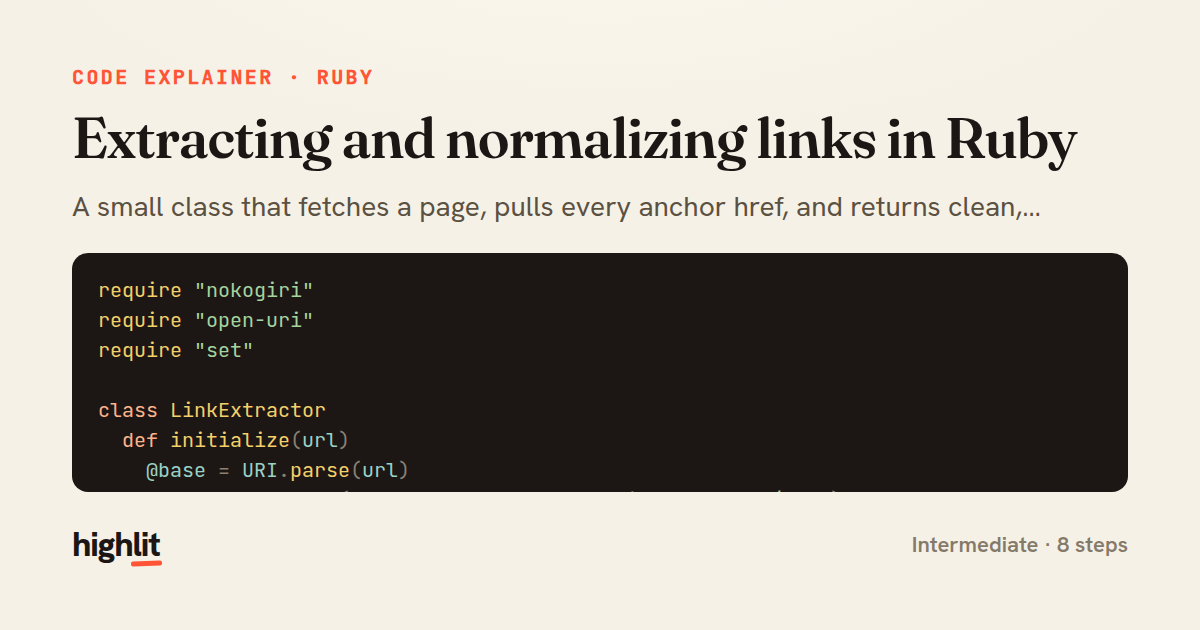
A small class that fetches a page, pulls every anchor href, and returns clean, absolute, deduplicated URLs.
Explained by
highlit
1require "nokogiri"
2require "open-uri"
3require "set"
4
5class LinkExtractor
6 def initialize(url)
7 @base = URI.parse(url)
8 @html = URI.open(url, "User-Agent" => "LinkExtractor/1.0").read
9 @doc = Nokogiri::HTML(@html)
10 end
11
12 def links
13 @doc.css("a[href]").each_with_object(Set.new) do |anchor, acc|
14 href = anchor["href"].to_s.strip
15 next if href.empty? || href.start_with?("#", "javascript:", "mailto:", "tel:")
16
17 absolute = normalize(href)
18 acc << absolute if absolute
19 end.to_a
20 end
21
22 def internal_links
23 links.select { |link| URI.parse(link).host == @base.host }
24 end
25
26 private
27
28 def normalize(href)
29 resolved = @base.merge(href)
30 resolved.fragment = nil
31 resolved.to_s
32 rescue URI::InvalidURIError
33 nil
34 end
35end
01 / 01
STEP 01
‹ swipe to step through ›
Walkthrough
Space play
←→ step
click any line
Three takeaways
- 1Resolving relative hrefs against a base URI turns fragile page-local links into usable absolute URLs.
- 2Building results into a Set gives you free deduplication before converting back to an array.
- 3Wrapping URI parsing in a rescue keeps one malformed link from crashing the whole extraction.
Related explainers
rust
use serde::Deserialize;

#[derive(Debug, Deserialize)]
#[serde(untagged)]
Parsing flexible JSON shapes with serde
deserialization
enums
json
Intermediate
6 steps
ruby
require "shellwords"
require "open3"

module Backup
Building safe shell commands in Ruby
shell-out
subprocess
command-injection
Intermediate
7 steps
ruby
class UserAgentParser
  BROWSERS = [
    [/Edg\/([\d.]+)/, "Edge"],
    [/OPR\/([\d.]+)/, "Opera"],
Parsing user-agent strings in Ruby
regex
pattern-matching
lookup-tables
Intermediate
8 steps
ruby
class LogAggregator
  BUCKET_FORMAT = "%Y-%m-%dT%H:%M"

  def initialize(entries)
Bucketing log entries by the minute in Ruby
aggregation
hashing
enumerable
Intermediate
5 steps
ruby
class WeeklySignupsReport
  DEFAULT_WEEKS = 12

  def initialize(weeks: DEFAULT_WEEKS, source: User.all)
Building a weekly signups report in Rails
service object
aggregation
group by
Intermediate
7 steps
rust
use chrono::{Duration, NaiveDate};

#[derive(Debug)]
pub struct DateRange {
Parsing and iterating date ranges in Rust
error-handling
iterators
parsing
Intermediate
7 steps
Share this explainer
Here's the card — post it anywhere.
Made with highlit — turn any snippet into a walkthrough like this in about a minute.
Explain your code
Embed this explainer
Drop the interactive walkthrough into a blog or docs. Views never cost a credit.
<iframe src="https://highlit.co/explainers/extracting-and-normalizing-links-in-ruby-explained-ruby-c3fa/embed?autoplay=1" width="100%" height="520" loading="lazy" style="border:0"></iframe>
Autoplay is on by default — add ?autoplay=0 to start paused.