go
56 lines · 9 steps
Handling multipart uploads in Gin
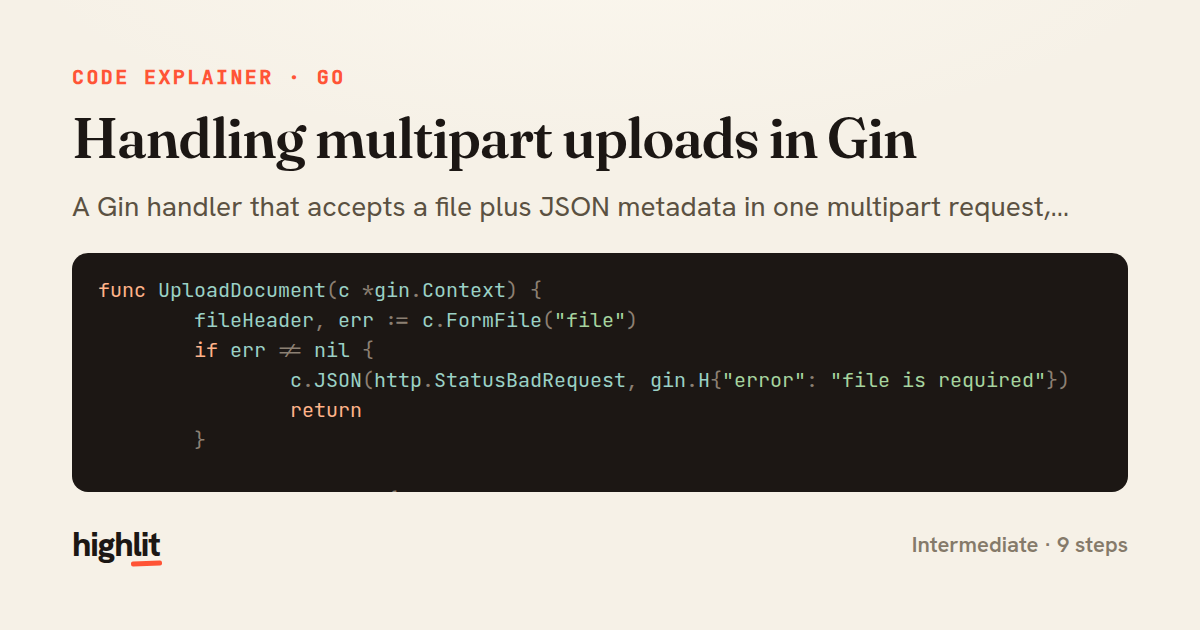
A Gin handler that accepts a file plus JSON metadata in one multipart request, validating each part before storing.
Explained by
highlit
1func UploadDocument(c *gin.Context) {
2 fileHeader, err := c.FormFile("file")
3 if err != nil {
4 c.JSON(http.StatusBadRequest, gin.H{"error": "file is required"})
5 return
6 }
7
8 var meta struct {
9 Title string `json:"title" binding:"required"`
10 Tags []string `json:"tags"`
11 OwnerID int64 `json:"owner_id" binding:"required"`
12 IsPublic bool `json:"is_public"`
13 }
14
15 raw := c.PostForm("metadata")
16 if raw == "" {
17 c.JSON(http.StatusBadRequest, gin.H{"error": "metadata field is required"})
18 return
19 }
20
21 if err := json.Unmarshal([]byte(raw), &meta); err != nil {
22 c.JSON(http.StatusBadRequest, gin.H{"error": "invalid metadata json"})
23 return
24 }
25
26 if err := binding.Validator.ValidateStruct(&meta); err != nil {
27 c.JSON(http.StatusUnprocessableEntity, gin.H{"error": err.Error()})
28 return
29 }
30
31 if fileHeader.Size > maxUploadBytes {
32 c.JSON(http.StatusRequestEntityTooLarge, gin.H{"error": "file too large"})
33 return
34 }
35
36 src, err := fileHeader.Open()
37 if err != nil {
38 c.JSON(http.StatusInternalServerError, gin.H{"error": "could not read upload"})
39 return
40 }
41 defer src.Close()
42
43 doc, err := documents.Store(c.Request.Context(), src, documents.Options{
44 Filename: fileHeader.Filename,
45 Title: meta.Title,
46 Tags: meta.Tags,
47 OwnerID: meta.OwnerID,
48 IsPublic: meta.IsPublic,
49 })
50 if err != nil {
51 c.JSON(http.StatusBadGateway, gin.H{"error": "storage failed"})
52 return
53 }
54
55 c.JSON(http.StatusCreated, doc)
56}
01 / 01
STEP 01
‹ swipe to step through ›
Walkthrough
Space play
←→ step
click any line
Three takeaways
- 1Multipart requests can carry both binary files and structured JSON, so parse and validate each part separately.
- 2Validate cheaply first and stream the file only once every check has passed to avoid wasted work.
- 3Mapping each failure class to a distinct HTTP status makes the API's errors self-explanatory to clients.
Related explainers
rust
use serde::Deserialize;

#[derive(Debug, Deserialize)]
#[serde(untagged)]
Parsing flexible JSON shapes with serde
deserialization
enums
json
Intermediate
6 steps
ruby
require "shellwords"
require "open3"

module Backup
Building safe shell commands in Ruby
shell-out
subprocess
command-injection
Intermediate
7 steps
go
package streaming

import (
	"bufio"
Streaming NDJSON logs over HTTP in Go
http-streaming
channels
select
Advanced
10 steps
php
<?php

namespace App\Services\Checkout;
Validating coupons with Laravel's Pipeline
pipeline
chain of responsibility
transactions
Intermediate
7 steps
go
package api

import (
	"crypto/sha256"
ETag conditional requests in Gin
http-caching
etag
conditional-requests
Intermediate
6 steps
php
<?php

namespace App\Services;
How a password strength validator works in PHP
validation
regular-expressions
data-driven
Intermediate
8 steps
Share this explainer
Here's the card — post it anywhere.
Made with highlit — turn any snippet into a walkthrough like this in about a minute.
Explain your code
Embed this explainer
Drop the interactive walkthrough into a blog or docs. Views never cost a credit.
<iframe src="https://highlit.co/explainers/handling-multipart-uploads-in-gin-explained-go-2e65/embed?autoplay=1" width="100%" height="520" loading="lazy" style="border:0"></iframe>
Autoplay is on by default — add ?autoplay=0 to start paused.