typescript
73 lines · 9 steps
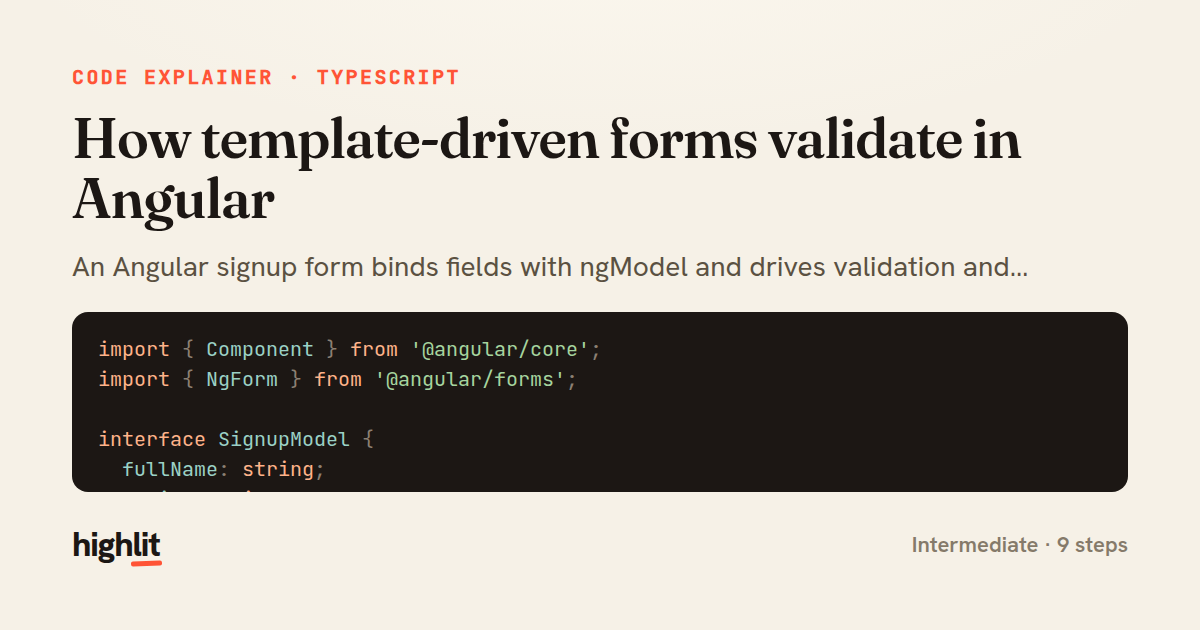
How template-driven forms validate in Angular
An Angular signup form binds fields with ngModel and drives validation and submission from template references.
Explained by
highlit
1import { Component } from '@angular/core';
2import { NgForm } from '@angular/forms';
3
4interface SignupModel {
5 fullName: string;
6 email: string;
7 age: number | null;
8}
9
10@Component({
11 selector: 'app-signup-form',
12 template: `
13 <form #signupForm="ngForm" (ngSubmit)="onSubmit(signupForm)" novalidate>
14 <label>
15 Full name
16 <input
17 name="fullName"
18 [(ngModel)]="model.fullName"
19 #fullName="ngModel"
20 required
21 minlength="3" />
22 </label>
23 <div class="error" *ngIf="fullName.invalid && (fullName.dirty || fullName.touched)">
24 <small *ngIf="fullName.errors?.['required']">Name is required.</small>
25 <small *ngIf="fullName.errors?.['minlength']">At least 3 characters.</small>
26 </div>
27
28 <label>
29 Email
30 <input
31 name="email"
32 type="email"
33 [(ngModel)]="model.email"
34 #email="ngModel"
35 required
36 email />
37 </label>
38 <div class="error" *ngIf="email.invalid && email.touched">
39 <small *ngIf="email.errors?.['required']">Email is required.</small>
40 <small *ngIf="email.errors?.['email']">Enter a valid email address.</small>
41 </div>
42
43 <label>
44 Age
45 <input
46 name="age"
47 type="number"
48 [(ngModel)]="model.age"
49 #age="ngModel"
50 required
51 min="18" />
52 </label>
53 <div class="error" *ngIf="age.invalid && age.touched">
54 <small *ngIf="age.errors?.['required']">Age is required.</small>
55 <small *ngIf="age.errors?.['min']">You must be at least 18.</small>
56 </div>
57
58 <button type="submit" [disabled]="signupForm.invalid">Create account</button>
59 </form>
60 `,
61})
62export class SignupFormComponent {
63 model: SignupModel = { fullName: '', email: '', age: null };
64
65 onSubmit(form: NgForm): void {
66 if (form.invalid) {
67 form.control.markAllAsTouched();
68 return;
69 }
70 console.log('Submitting', this.model);
71 form.resetForm();
72 }
73}
01 / 01
STEP 01
‹ swipe to step through ›
Walkthrough
Space play
←→ step
click any line
Three takeaways
- 1Template-driven forms let the template own validation state via exported ngModel and ngForm references.
- 2Two-way ngModel binding keeps a typed model object in sync with the inputs automatically.
- 3Guarding error messages behind dirty or touched prevents warnings from flashing before the user interacts.
Related explainers
typescript
import { registerLocaleData } from '@angular/common';
import localeFr from '@angular/common/locales/fr';
import localeFrExtra from '@angular/common/locales/extra/fr';
import localeDe from '@angular/common/locales/de';
Locale-aware bootstrapping in Angular
i18n
localization
dependency-injection
Intermediate
8 steps
typescript
import { Module } from '@nestjs/common';
import { ConfigModule } from '@nestjs/config';
import * as Joi from 'joi';
Validating env config at boot in NestJS
configuration
schema-validation
environment-variables
Intermediate
8 steps
php
<?php

namespace App\Services\Checkout;
Validating coupons with Laravel's Pipeline
pipeline
chain of responsibility
transactions
Intermediate
7 steps
typescript
import { Inject, Injectable, Logger } from '@nestjs/common';
import { CACHE_MANAGER } from '@nestjs/cache-manager';
import { Cache } from 'cache-manager';
import { InjectRepository } from '@nestjs/typeorm';
A cache-aside country lookup in NestJS
cache-aside
dependency-injection
batch-lookup
Intermediate
8 steps
php
<?php

namespace App\Services;
How a password strength validator works in PHP
validation
regular-expressions
data-driven
Intermediate
8 steps
typescript
import { Injectable, effect, signal, computed } from '@angular/core';

interface Preferences {
  theme: 'light' | 'dark';
A signal-based preferences store in Angular
signals
state-management
persistence
Intermediate
7 steps
Share this explainer
Here's the card — post it anywhere.
Made with highlit — turn any snippet into a walkthrough like this in about a minute.
Explain your code
Embed this explainer
Drop the interactive walkthrough into a blog or docs. Views never cost a credit.
<iframe src="https://highlit.co/explainers/how-template-driven-forms-validate-in-angular-explained-typescript-5cea/embed?autoplay=1" width="100%" height="520" loading="lazy" style="border:0"></iframe>
Autoplay is on by default — add ?autoplay=0 to start paused.