python
41 lines · 6 steps
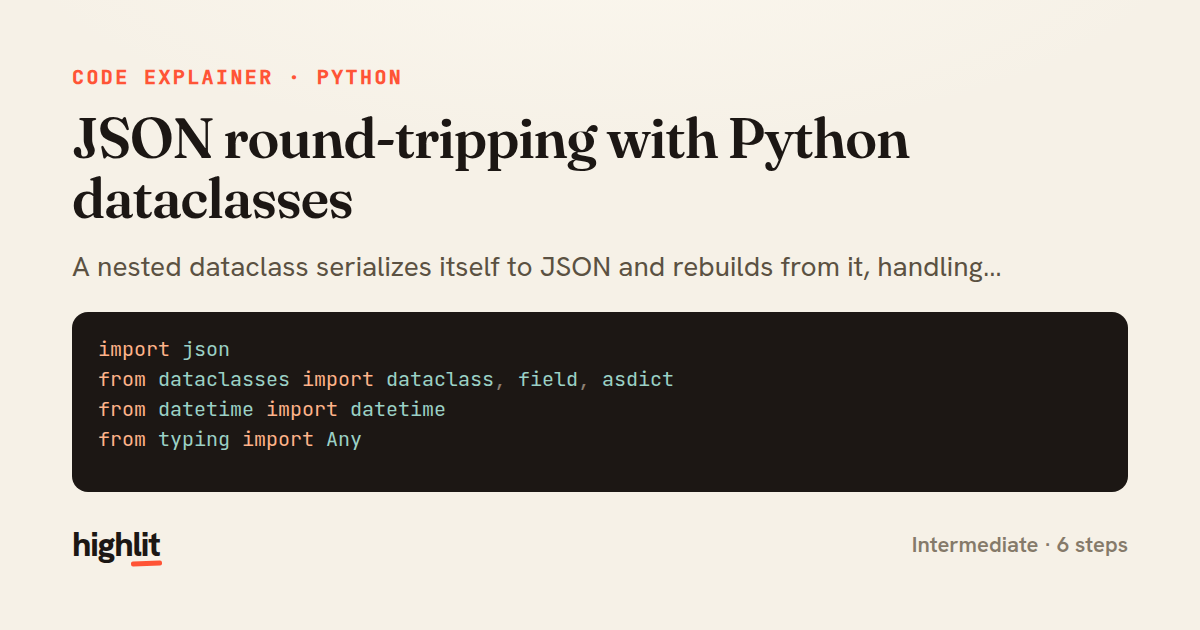
JSON round-tripping with Python dataclasses
A nested dataclass serializes itself to JSON and rebuilds from it, handling datetimes and nested objects along the way.
Explained by
highlit
1import json
2from dataclasses import dataclass, field, asdict
3from datetime import datetime
4from typing import Any
5
6
7@dataclass
8class Address:
9 street: str
10 city: str
11 zip_code: str
12
13
14@dataclass
15class User:
16 id: int
17 name: str
18 email: str
19 address: Address
20 tags: list[str] = field(default_factory=list)
21 created_at: datetime = field(default_factory=datetime.utcnow)
22
23 def to_json(self, **kwargs: Any) -> str:
24 def default(obj: Any) -> Any:
25 if isinstance(obj, datetime):
26 return obj.isoformat()
27 raise TypeError(f"Cannot serialize {type(obj).__name__}")
28
29 return json.dumps(asdict(self), default=default, **kwargs)
30
31 @classmethod
32 def from_json(cls, raw: str) -> "User":
33 data = json.loads(raw)
34 return cls(
35 id=data["id"],
36 name=data["name"],
37 email=data["email"],
38 address=Address(**data["address"]),
39 tags=data.get("tags", []),
40 created_at=datetime.fromisoformat(data["created_at"]),
41 )
01 / 01
STEP 01
‹ swipe to step through ›
Walkthrough
Space play
←→ step
click any line
Three takeaways
- 1asdict recursively flattens nested dataclasses into plain dicts ready for json.dumps.
- 2json.dumps accepts a default callback to teach it how to serialize types it doesn't natively understand, like datetime.
- 3Reconstruction is manual because JSON has no type info, so nested objects and datetimes must be rebuilt field by field.
Related explainers
rust
use serde::Deserialize;

#[derive(Debug, Deserialize)]
#[serde(untagged)]
Parsing flexible JSON shapes with serde
deserialization
enums
json
Intermediate
6 steps
python
from fastapi import FastAPI, WebSocket, WebSocketDisconnect

app = FastAPI()
Building a WebSocket chat with FastAPI
websockets
broadcast
connection-management
Intermediate
9 steps
python
import time
import uuid

from django.utils.deprecation import MiddlewareMixin
Attaching per-request context in Django
middleware
request lifecycle
multi-tenancy
Intermediate
7 steps
rust
use axum::{
    extract::{Path, State},
    response::sse::{Event, KeepAlive, Sse},
};
Streaming import progress with SSE in Axum
server-sent-events
streams
watch-channel
Advanced
7 steps
python
import random
from typing import Iterator, List
How reservoir sampling picks k items
reservoir-sampling
streaming
randomness
Intermediate
5 steps
python
import secrets

from django.contrib.auth import authenticate, login
from django.core.cache import cache
Two-factor login with OTP in Django
two-factor-auth
one-time-passwords
caching
Intermediate
9 steps
Share this explainer
Here's the card — post it anywhere.
Made with highlit — turn any snippet into a walkthrough like this in about a minute.
Explain your code
Embed this explainer
Drop the interactive walkthrough into a blog or docs. Views never cost a credit.
<iframe src="https://highlit.co/explainers/json-round-tripping-with-python-dataclasses-explained-python-aa70/embed?autoplay=1" width="100%" height="520" loading="lazy" style="border:0"></iframe>
Autoplay is on by default — add ?autoplay=0 to start paused.