typescript
50 lines · 7 steps
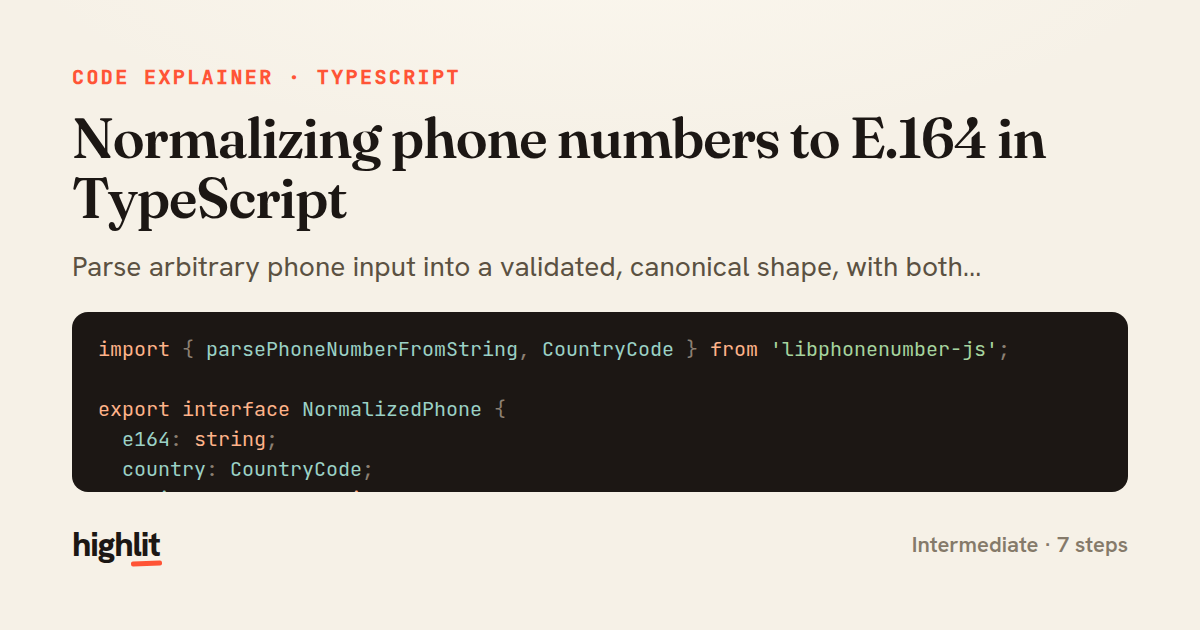
Normalizing phone numbers to E.164 in TypeScript
Parse arbitrary phone input into a validated, canonical shape, with both throwing and safe variants.
Explained by
highlit
1import { parsePhoneNumberFromString, CountryCode } from 'libphonenumber-js';
2
3export interface NormalizedPhone {
4 e164: string;
5 country: CountryCode;
6 nationalNumber: string;
7 type: string | undefined;
8}
9
10export class InvalidPhoneNumberError extends Error {
11 constructor(input: string) {
12 super(`Invalid phone number: ${input}`);
13 this.name = 'InvalidPhoneNumberError';
14 }
15}
16
17export function normalizePhoneNumber(
18 input: string,
19 defaultCountry: CountryCode = 'US',
20): NormalizedPhone {
21 const trimmed = input.trim();
22
23 if (!trimmed) {
24 throw new InvalidPhoneNumberError(input);
25 }
26
27 const parsed = parsePhoneNumberFromString(trimmed, defaultCountry);
28
29 if (!parsed || !parsed.isValid()) {
30 throw new InvalidPhoneNumberError(input);
31 }
32
33 return {
34 e164: parsed.number,
35 country: parsed.country ?? defaultCountry,
36 nationalNumber: parsed.nationalNumber,
37 type: parsed.getType(),
38 };
39}
40
41export function tryNormalizePhoneNumber(
42 input: string,
43 defaultCountry: CountryCode = 'US',
44): NormalizedPhone | null {
45 try {
46 return normalizePhoneNumber(input, defaultCountry);
47 } catch {
48 return null;
49 }
50}
01 / 01
STEP 01
‹ swipe to step through ›
Walkthrough
Space play
←→ step
click any line
Three takeaways
- 1Normalizing to a canonical format like E.164 makes stored phone numbers comparable and unambiguous.
- 2A custom error subclass lets callers distinguish invalid input from other failures precisely.
- 3Offering both a throwing and a try/catch-wrapping variant lets callers choose the ergonomics they want.
Related explainers
typescript
import { registerLocaleData } from '@angular/common';
import localeFr from '@angular/common/locales/fr';
import localeFrExtra from '@angular/common/locales/extra/fr';
import localeDe from '@angular/common/locales/de';
Locale-aware bootstrapping in Angular
i18n
localization
dependency-injection
Intermediate
8 steps
php
<?php

class NameParser
{
Parsing a full name into components in PHP
string-parsing
arrays
normalization
Intermediate
8 steps
rust
use serde::Deserialize;

#[derive(Debug, Deserialize)]
#[serde(untagged)]
Parsing flexible JSON shapes with serde
deserialization
enums
json
Intermediate
6 steps
ruby
require "shellwords"
require "open3"

module Backup
Building safe shell commands in Ruby
shell-out
subprocess
command-injection
Intermediate
7 steps
typescript
import { Module } from '@nestjs/common';
import { ConfigModule } from '@nestjs/config';
import * as Joi from 'joi';
Validating env config at boot in NestJS
configuration
schema-validation
environment-variables
Intermediate
8 steps
php
<?php

namespace App\Services\Checkout;
Validating coupons with Laravel's Pipeline
pipeline
chain of responsibility
transactions
Intermediate
7 steps
Share this explainer
Here's the card — post it anywhere.
Made with highlit — turn any snippet into a walkthrough like this in about a minute.
Explain your code
Embed this explainer
Drop the interactive walkthrough into a blog or docs. Views never cost a credit.
<iframe src="https://highlit.co/explainers/normalizing-phone-numbers-to-e-164-in-typescript-explained-typescript-f31e/embed?autoplay=1" width="100%" height="520" loading="lazy" style="border:0"></iframe>
Autoplay is on by default — add ?autoplay=0 to start paused.