java
57 lines · 9 steps
Parsing and building URL query strings in Java
An immutable-ish wrapper that parses a URI's query into a multimap and rebuilds it, handling repeated keys and encoding.
Explained by
highlit
1public final class QueryParams {
2
3 private final Map<String, List<String>> params;
4
5 private QueryParams(Map<String, List<String>> params) {
6 this.params = params;
7 }
8
9 public static QueryParams parse(URI uri) {
10 String query = uri.getRawQuery();
11 Map<String, List<String>> parsed = new LinkedHashMap<>();
12 if (query == null || query.isEmpty()) {
13 return new QueryParams(parsed);
14 }
15 for (String pair : query.split("&")) {
16 int eq = pair.indexOf('=');
17 String key = eq >= 0 ? pair.substring(0, eq) : pair;
18 String value = eq >= 0 ? pair.substring(eq + 1) : "";
19 parsed.computeIfAbsent(decode(key), k -> new ArrayList<>()).add(decode(value));
20 }
21 return new QueryParams(parsed);
22 }
23
24 public Optional<String> first(String key) {
25 List<String> values = params.get(key);
26 return values == null || values.isEmpty() ? Optional.empty() : Optional.of(values.get(0));
27 }
28
29 public List<String> all(String key) {
30 return params.getOrDefault(key, List.of());
31 }
32
33 public QueryParams with(String key, String value) {
34 params.computeIfAbsent(key, k -> new ArrayList<>()).add(value);
35 return this;
36 }
37
38 public QueryParams without(String key) {
39 params.remove(key);
40 return this;
41 }
42
43 public String toQueryString() {
44 StringJoiner joiner = new StringJoiner("&");
45 params.forEach((key, values) -> values.forEach(v ->
46 joiner.add(encode(key) + "=" + encode(v))));
47 return joiner.toString();
48 }
49
50 private static String decode(String s) {
51 return URLDecoder.decode(s, StandardCharsets.UTF_8);
52 }
53
54 private static String encode(String s) {
55 return URLEncoder.encode(s, StandardCharsets.UTF_8);
56 }
57}
01 / 01
STEP 01
‹ swipe to step through ›
Walkthrough
Space play
←→ step
click any line
Three takeaways
- 1Query keys can repeat, so a Map of List models them correctly where a plain Map would silently drop values.
- 2computeIfAbsent lets you lazily create the inner collection only when a key first appears.
- 3Always decode on parse and encode on output so special characters survive a round trip.
Related explainers
ruby
class UserAgentParser
  BROWSERS = [
    [/Edg\/([\d.]+)/, "Edge"],
    [/OPR\/([\d.]+)/, "Opera"],
Parsing user-agent strings in Ruby
regex
pattern-matching
lookup-tables
Intermediate
8 steps
java
@Component
@Converter
public class EncryptedStringConverter implements AttributeConverter<String, String> {
Transparent column encryption in Spring & JPA
encryption
aes-gcm
jpa-converter
Advanced
10 steps
javascript
function evaluate(expression) {
  const tokens = tokenize(expression);
  let pos = 0;
Building a recursive descent calculator
parsing
recursion
operator-precedence
Intermediate
8 steps
java
package com.acme.billing.config;

import org.springframework.boot.autoconfigure.condition.ConditionalOnProperty;
import org.springframework.boot.context.properties.ConfigurationProperties;
Feature-flagged beans with Spring @ConditionalOnProperty
feature-flags
conditional-beans
strategy-pattern
Intermediate
5 steps
rust
use chrono::{Duration, NaiveDate};

#[derive(Debug)]
pub struct DateRange {
Parsing and iterating date ranges in Rust
error-handling
iterators
parsing
Intermediate
7 steps
java
public static Map<String, String> parseCookieHeader(String header) {
    Map<String, String> cookies = new LinkedHashMap<>();
    if (header == null || header.isBlank()) {
        return cookies;
Parsing an HTTP Cookie header in Java
string-parsing
http
url-decoding
Intermediate
6 steps
Share this explainer
Here's the card — post it anywhere.
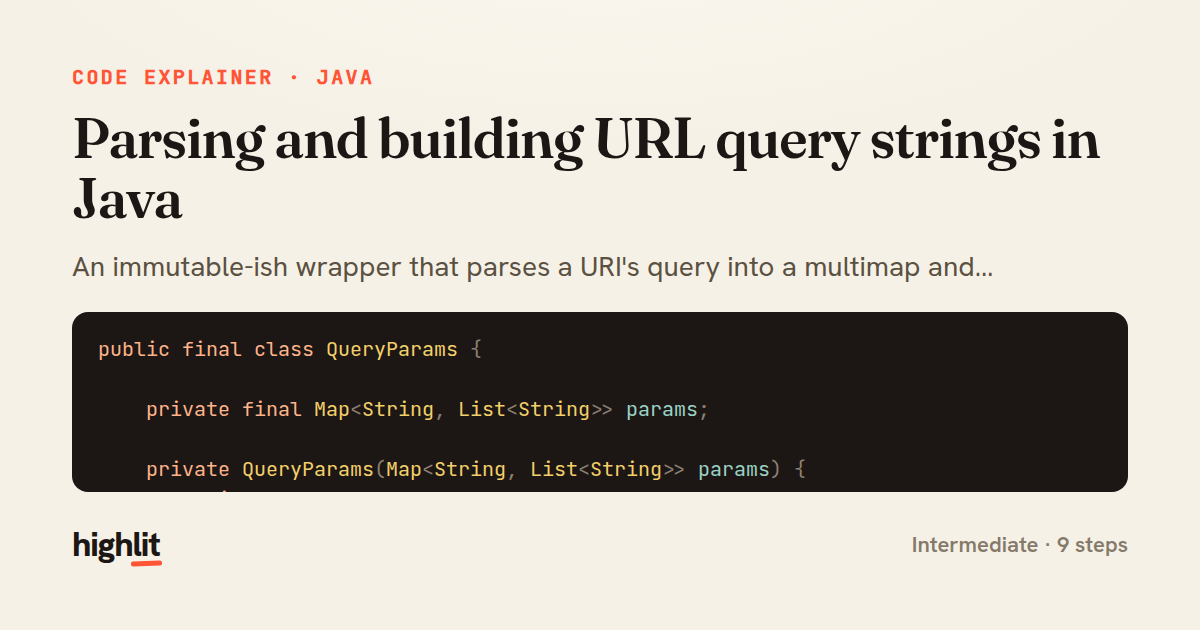
Made with highlit — turn any snippet into a walkthrough like this in about a minute.
Explain your code
Embed this explainer
Drop the interactive walkthrough into a blog or docs. Views never cost a credit.
<iframe src="https://highlit.co/explainers/parsing-and-building-url-query-strings-in-java-explained-java-bc66/embed?autoplay=1" width="100%" height="520" loading="lazy" style="border:0"></iframe>
Autoplay is on by default — add ?autoplay=0 to start paused.