typescript
61 lines · 8 steps
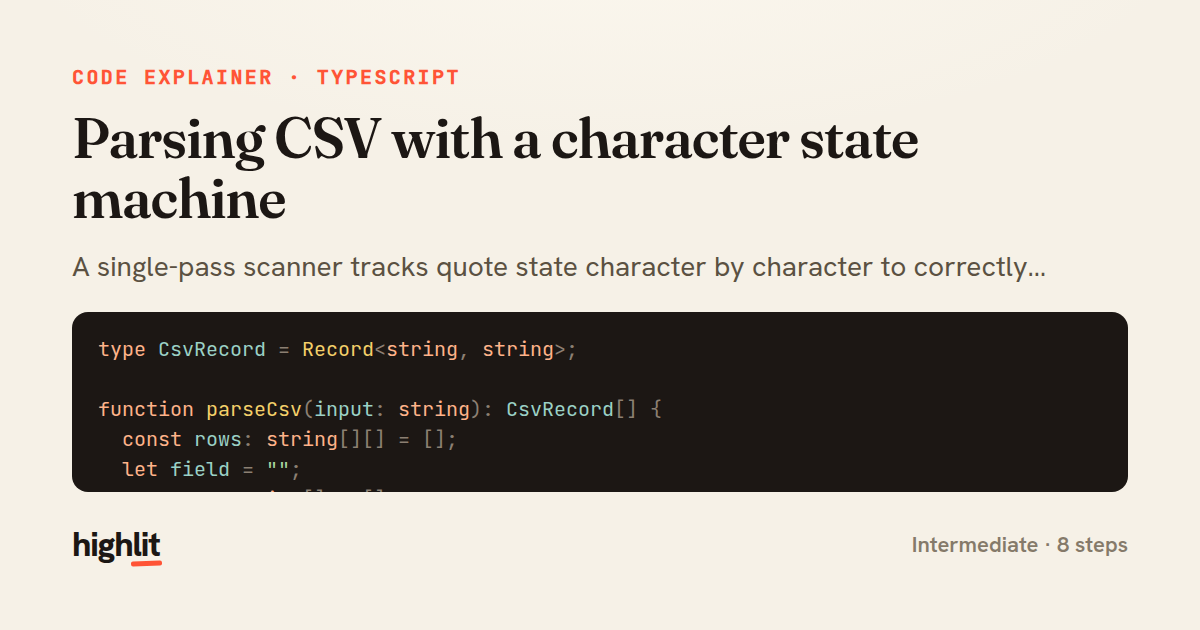
Parsing CSV with a character state machine
A single-pass scanner tracks quote state character by character to correctly split CSV into rows, fields, and typed records.
Explained by
highlit
1type CsvRecord = Record<string, string>;
2
3function parseCsv(input: string): CsvRecord[] {
4 const rows: string[][] = [];
5 let field = "";
6 let row: string[] = [];
7 let inQuotes = false;
8
9 for (let i = 0; i < input.length; i++) {
10 const char = input[i];
11
12 if (inQuotes) {
13 if (char === '"') {
14 if (input[i + 1] === '"') {
15 field += '"';
16 i++;
17 } else {
18 inQuotes = false;
19 }
20 } else {
21 field += char;
22 }
23 continue;
24 }
25
26 switch (char) {
27 case '"':
28 inQuotes = true;
29 break;
30 case ",":
31 row.push(field);
32 field = "";
33 break;
34 case "\r":
35 break;
36 case "\n":
37 row.push(field);
38 rows.push(row);
39 field = "";
40 row = [];
41 break;
42 default:
43 field += char;
44 }
45 }
46
47 if (field.length > 0 || row.length > 0) {
48 row.push(field);
49 rows.push(row);
50 }
51
52 const [header, ...body] = rows;
53 if (!header) return [];
54
55 return body.map((cells) =>
56 header.reduce<CsvRecord>((record, key, index) => {
57 record[key] = cells[index] ?? "";
58 return record;
59 }, {})
60 );
61}
01 / 01
STEP 01
‹ swipe to step through ›
Walkthrough
Space play
←→ step
click any line
Three takeaways
- 1Tracking a small amount of state like inQuotes turns naive splitting into a correct parser that handles edge cases.
- 2Quoted fields need special handling for embedded delimiters and doubled quotes as escaped literals.
- 3Separating tokenization from record assembly keeps each phase simple and easy to reason about.
Related explainers
typescript
import { registerLocaleData } from '@angular/common';
import localeFr from '@angular/common/locales/fr';
import localeFrExtra from '@angular/common/locales/extra/fr';
import localeDe from '@angular/common/locales/de';
Locale-aware bootstrapping in Angular
i18n
localization
dependency-injection
Intermediate
8 steps
typescript
import { Module } from '@nestjs/common';
import { ConfigModule } from '@nestjs/config';
import * as Joi from 'joi';
Validating env config at boot in NestJS
configuration
schema-validation
environment-variables
Intermediate
8 steps
ruby
class UserAgentParser
  BROWSERS = [
    [/Edg\/([\d.]+)/, "Edge"],
    [/OPR\/([\d.]+)/, "Opera"],
Parsing user-agent strings in Ruby
regex
pattern-matching
lookup-tables
Intermediate
8 steps
javascript
function evaluate(expression) {
  const tokens = tokenize(expression);
  let pos = 0;
Building a recursive descent calculator
parsing
recursion
operator-precedence
Intermediate
8 steps
typescript
import { Inject, Injectable, Logger } from '@nestjs/common';
import { CACHE_MANAGER } from '@nestjs/cache-manager';
import { Cache } from 'cache-manager';
import { InjectRepository } from '@nestjs/typeorm';
A cache-aside country lookup in NestJS
cache-aside
dependency-injection
batch-lookup
Intermediate
8 steps
typescript
import { Injectable, effect, signal, computed } from '@angular/core';

interface Preferences {
  theme: 'light' | 'dark';
A signal-based preferences store in Angular
signals
state-management
persistence
Intermediate
7 steps
Share this explainer
Here's the card — post it anywhere.
Made with highlit — turn any snippet into a walkthrough like this in about a minute.
Explain your code
Embed this explainer
Drop the interactive walkthrough into a blog or docs. Views never cost a credit.
<iframe src="https://highlit.co/explainers/parsing-csv-with-a-character-state-machine-explained-typescript-3a66/embed?autoplay=1" width="100%" height="520" loading="lazy" style="border:0"></iframe>
Autoplay is on by default — add ?autoplay=0 to start paused.