ruby
32 lines · 7 steps
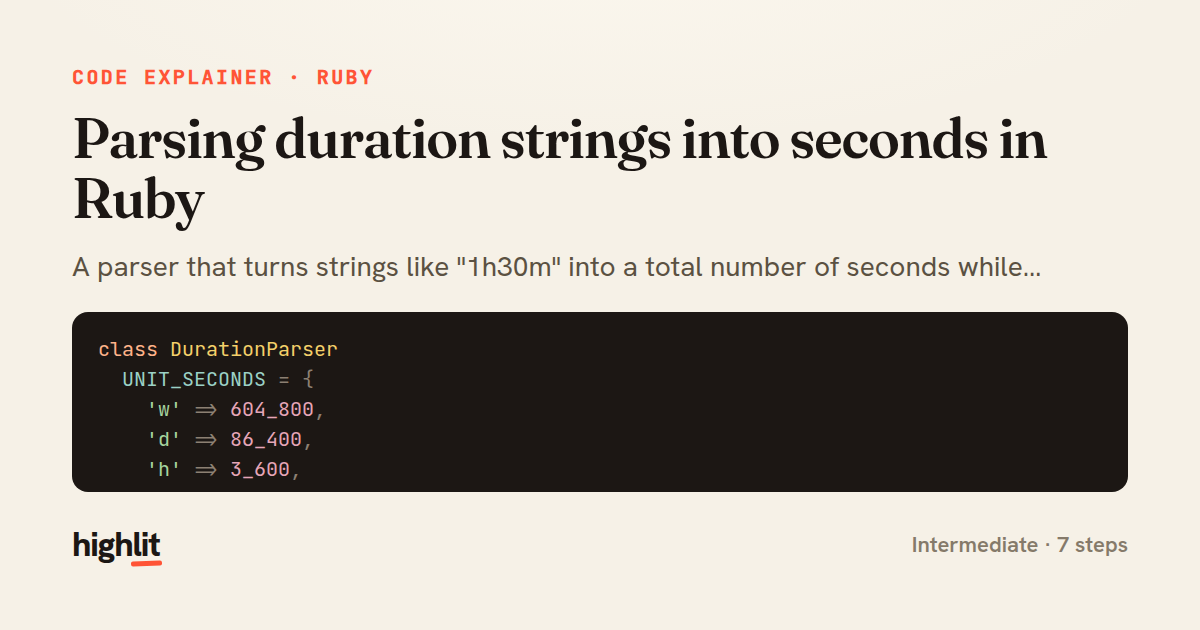
Parsing duration strings into seconds in Ruby
A parser that turns strings like "1h30m" into a total number of seconds while rejecting malformed input.
Explained by
highlit
1class DurationParser
2 UNIT_SECONDS = {
3 'w' => 604_800,
4 'd' => 86_400,
5 'h' => 3_600,
6 'm' => 60,
7 's' => 1
8 }.freeze
9
10 TOKEN = /(\d+)([wdhms])/
11
12 class InvalidDuration < StandardError; end
13
14 def self.parse(input)
15 normalized = input.to_s.strip.downcase
16 raise InvalidDuration, "empty duration" if normalized.empty?
17
18 remaining = normalized.dup
19 total = 0
20
21 remaining.gsub!(TOKEN) do
22 total += Regexp.last_match(1).to_i * UNIT_SECONDS.fetch(Regexp.last_match(2))
23 ''
24 end
25
26 unless remaining.empty?
27 raise InvalidDuration, "unexpected characters in #{input.inspect}"
28 end
29
30 total
31 end
32end
01 / 01
STEP 01
‹ swipe to step through ›
Walkthrough
Space play
←→ step
click any line
Three takeaways
- 1A frozen constant lookup table keeps unit conversions in one readable place.
- 2Consuming matches with a destructive gsub lets leftover characters double as a validation check.
- 3Raising a custom error class makes invalid input explicit rather than silently producing wrong numbers.
Related explainers
ruby
require "shellwords"
require "open3"

module Backup
Building safe shell commands in Ruby
shell-out
subprocess
command-injection
Intermediate
7 steps
php
<?php

namespace App\Services\Checkout;
Validating coupons with Laravel's Pipeline
pipeline
chain of responsibility
transactions
Intermediate
7 steps
ruby
class UserAgentParser
  BROWSERS = [
    [/Edg\/([\d.]+)/, "Edge"],
    [/OPR\/([\d.]+)/, "Opera"],
Parsing user-agent strings in Ruby
regex
pattern-matching
lookup-tables
Intermediate
8 steps
javascript
function evaluate(expression) {
  const tokens = tokenize(expression);
  let pos = 0;
Building a recursive descent calculator
parsing
recursion
operator-precedence
Intermediate
8 steps
php
<?php

namespace App\Services;
How a password strength validator works in PHP
validation
regular-expressions
data-driven
Intermediate
8 steps
ruby
class LogAggregator
  BUCKET_FORMAT = "%Y-%m-%dT%H:%M"

  def initialize(entries)
Bucketing log entries by the minute in Ruby
aggregation
hashing
enumerable
Intermediate
5 steps
Share this explainer
Here's the card — post it anywhere.
Made with highlit — turn any snippet into a walkthrough like this in about a minute.
Explain your code
Embed this explainer
Drop the interactive walkthrough into a blog or docs. Views never cost a credit.
<iframe src="https://highlit.co/explainers/parsing-duration-strings-into-seconds-in-ruby-explained-ruby-a8d4/embed?autoplay=1" width="100%" height="520" loading="lazy" style="border:0"></iframe>
Autoplay is on by default — add ?autoplay=0 to start paused.