ruby
60 lines · 9 steps
Rate-limited CRM sync in a Rails job
A background job pushes contacts to a CRM while a Redis sliding window and a semaphore keep it under the API's limits.
Explained by
highlit
1class SyncContactsJob < ApplicationJob
2 queue_as :external_api
3
4 MAX_CONCURRENCY = 5
5 RATE_LIMIT_KEY = "crm:rate_limit".freeze
6
7 retry_on Crm::RateLimitedError, wait: :polynomially_longer, attempts: 8
8
9 def perform(account_id)
10 account = Account.find(account_id)
11
12 account.contacts.pending_sync.find_each do |contact|
13 throttle { Crm::Client.upsert_contact(contact) }
14 contact.update!(synced_at: Time.current, sync_status: :synced)
15 end
16 end
17
18 private
19
20 def throttle(&block)
21 semaphore.synchronize do
22 wait_for_rate_limit_slot
23 block.call
24 end
25 end
26
27 def semaphore
28 @semaphore ||= Concurrent::Semaphore.new(MAX_CONCURRENCY)
29 end
30
31 def wait_for_rate_limit_slot
32 loop do
33 allowed = redis.eval(
34 THROTTLE_SCRIPT,
35 keys: [RATE_LIMIT_KEY],
36 argv: [60, 100, Time.current.to_f]
37 )
38 break if allowed == 1
39
40 sleep(0.25 + rand * 0.25)
41 end
42 end
43
44 def redis
45 @redis ||= Redis.new(url: ENV.fetch("REDIS_URL"))
46 end
47
48 THROTTLE_SCRIPT = <<~LUA.freeze
49 local window = tonumber(ARGV[1])
50 local limit = tonumber(ARGV[2])
51 local now = tonumber(ARGV[3])
52 redis.call('ZREMRANGEBYSCORE', KEYS[1], 0, now - window)
53 if redis.call('ZCARD', KEYS[1]) < limit then
54 redis.call('ZADD', KEYS[1], now, now)
55 redis.call('EXPIRE', KEYS[1], window)
56 return 1
57 end
58 return 0
59 LUA
60end
01 / 01
STEP 01
‹ swipe to step through ›
Walkthrough
Space play
←→ step
click any line
Three takeaways
- 1A Redis sorted set makes an atomic sliding-window rate limiter that survives across processes.
- 2Combining a local semaphore with a shared rate limit bounds both in-process and cross-process concurrency.
- 3Declarative retries with exponential backoff let a job absorb upstream rate-limit errors gracefully.
Related explainers
ruby
require "shellwords"
require "open3"

module Backup
Building safe shell commands in Ruby
shell-out
subprocess
command-injection
Intermediate
7 steps
ruby
class UserAgentParser
  BROWSERS = [
    [/Edg\/([\d.]+)/, "Edge"],
    [/OPR\/([\d.]+)/, "Opera"],
Parsing user-agent strings in Ruby
regex
pattern-matching
lookup-tables
Intermediate
8 steps
ruby
class LogAggregator
  BUCKET_FORMAT = "%Y-%m-%dT%H:%M"

  def initialize(entries)
Bucketing log entries by the minute in Ruby
aggregation
hashing
enumerable
Intermediate
5 steps
go
func (w *Watcher) resetDebounce(d time.Duration) {
	if !w.timer.Stop() {
		select {
		case <-w.timer.C:
Debouncing a stream of events in Go
debounce
timers
channels
Advanced
7 steps
ruby
class WeeklySignupsReport
  DEFAULT_WEEKS = 12

  def initialize(weeks: DEFAULT_WEEKS, source: User.all)
Building a weekly signups report in Rails
service object
aggregation
group by
Intermediate
7 steps
ruby
class ApplicationController < ActionController::Base
  EXPERIMENTS = {
    checkout_button_color: %w[control blue green],
    onboarding_flow: %w[control streamlined]
How A/B test cohorts are assigned in Rails
a-b-testing
cookies
hashing
Intermediate
8 steps
Share this explainer
Here's the card — post it anywhere.
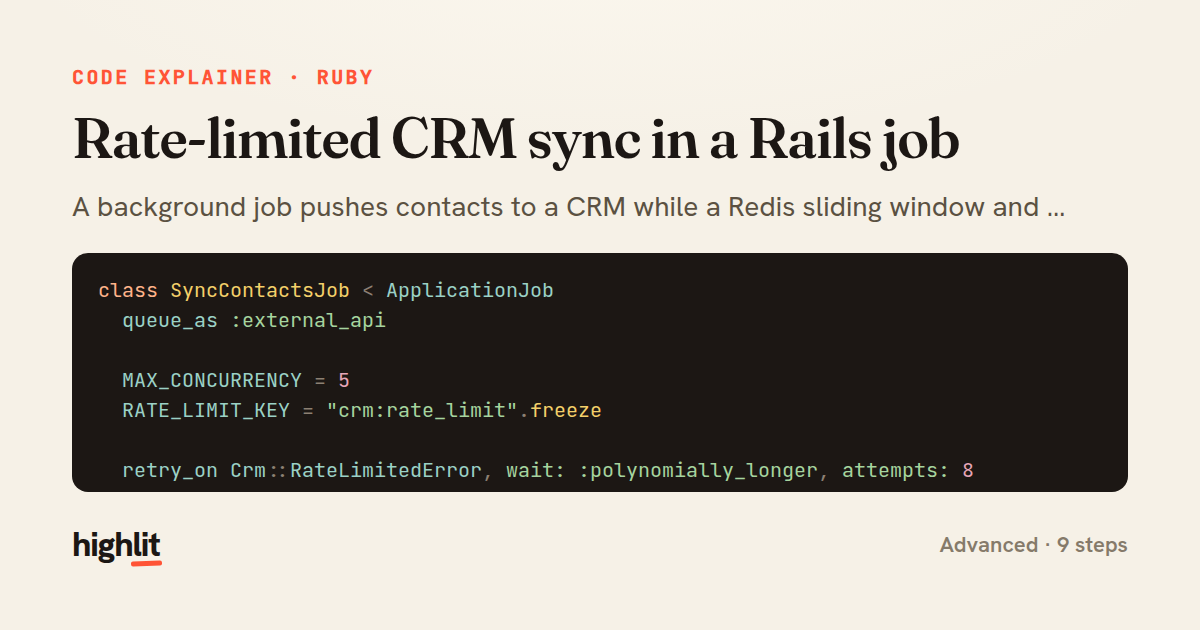
Made with highlit — turn any snippet into a walkthrough like this in about a minute.
Explain your code
Embed this explainer
Drop the interactive walkthrough into a blog or docs. Views never cost a credit.
<iframe src="https://highlit.co/explainers/rate-limited-crm-sync-in-a-rails-job-explained-ruby-d490/embed?autoplay=1" width="100%" height="520" loading="lazy" style="border:0"></iframe>
Autoplay is on by default — add ?autoplay=0 to start paused.