typescript
45 lines · 6 steps
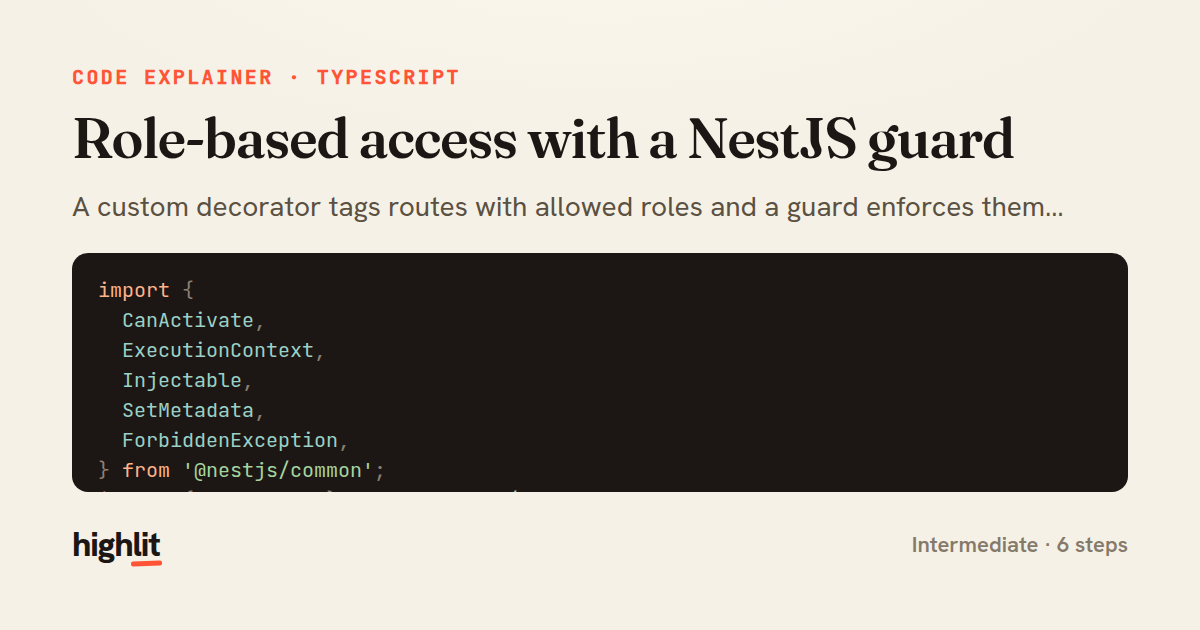
Role-based access with a NestJS guard
A custom decorator tags routes with allowed roles and a guard enforces them per request.
Explained by
highlit
1import {
2 CanActivate,
3 ExecutionContext,
4 Injectable,
5 SetMetadata,
6 ForbiddenException,
7} from '@nestjs/common';
8import { Reflector } from '@nestjs/core';
9
10export type AppRole = 'admin' | 'editor' | 'viewer';
11
12export const ROLES_KEY = 'roles';
13export const Roles = (...roles: AppRole[]) => SetMetadata(ROLES_KEY, roles);
14
15@Injectable()
16export class RolesGuard implements CanActivate {
17 constructor(private readonly reflector: Reflector) {}
18
19 canActivate(context: ExecutionContext): boolean {
20 const requiredRoles = this.reflector.getAllAndOverride<AppRole[]>(ROLES_KEY, [
21 context.getHandler(),
22 context.getClass(),
23 ]);
24
25 if (!requiredRoles?.length) {
26 return true;
27 }
28
29 const { user } = context.switchToHttp().getRequest();
30
31 if (!user) {
32 throw new ForbiddenException('Authentication required');
33 }
34
35 const granted = requiredRoles.some((role) => user.roles?.includes(role));
36
37 if (!granted) {
38 throw new ForbiddenException(
39 `Requires one of the following roles: ${requiredRoles.join(', ')}`,
40 );
41 }
42
43 return true;
44 }
45}
01 / 01
STEP 01
‹ swipe to step through ›
Walkthrough
Space play
←→ step
click any line
Three takeaways
- 1Decorators attach metadata that guards can read later at request time via the Reflector.
- 2getAllAndOverride lets method-level metadata override class-level defaults cleanly.
- 3Returning true from canActivate allows the request while throwing rejects it with a chosen status.
Related explainers
typescript
import { registerLocaleData } from '@angular/common';
import localeFr from '@angular/common/locales/fr';
import localeFrExtra from '@angular/common/locales/extra/fr';
import localeDe from '@angular/common/locales/de';
Locale-aware bootstrapping in Angular
i18n
localization
dependency-injection
Intermediate
8 steps
typescript
import { Module } from '@nestjs/common';
import { ConfigModule } from '@nestjs/config';
import * as Joi from 'joi';
Validating env config at boot in NestJS
configuration
schema-validation
environment-variables
Intermediate
8 steps
typescript
import { Inject, Injectable, Logger } from '@nestjs/common';
import { CACHE_MANAGER } from '@nestjs/cache-manager';
import { Cache } from 'cache-manager';
import { InjectRepository } from '@nestjs/typeorm';
A cache-aside country lookup in NestJS
cache-aside
dependency-injection
batch-lookup
Intermediate
8 steps
typescript
import { Injectable, effect, signal, computed } from '@angular/core';

interface Preferences {
  theme: 'light' | 'dark';
A signal-based preferences store in Angular
signals
state-management
persistence
Intermediate
7 steps
typescript
import { useEffect, useState } from "react";

interface Section {
  id: string;
Building a scroll-spy hook in React
custom-hooks
intersectionobserver
dom-observation
Intermediate
8 steps
typescript
import { Injectable, Scope, Inject, NotFoundException } from '@nestjs/common';
import { REQUEST } from '@nestjs/core';
import { Request } from 'express';
import { DataSource } from 'typeorm';
Per-tenant database connections in NestJS
multi-tenancy
connection-pooling
dependency-injection
Advanced
8 steps
Share this explainer
Here's the card — post it anywhere.
Made with highlit — turn any snippet into a walkthrough like this in about a minute.
Explain your code
Embed this explainer
Drop the interactive walkthrough into a blog or docs. Views never cost a credit.
<iframe src="https://highlit.co/explainers/role-based-access-with-a-nestjs-guard-explained-typescript-2067/embed?autoplay=1" width="100%" height="520" loading="lazy" style="border:0"></iframe>
Autoplay is on by default — add ?autoplay=0 to start paused.