ruby
43 lines · 7 steps
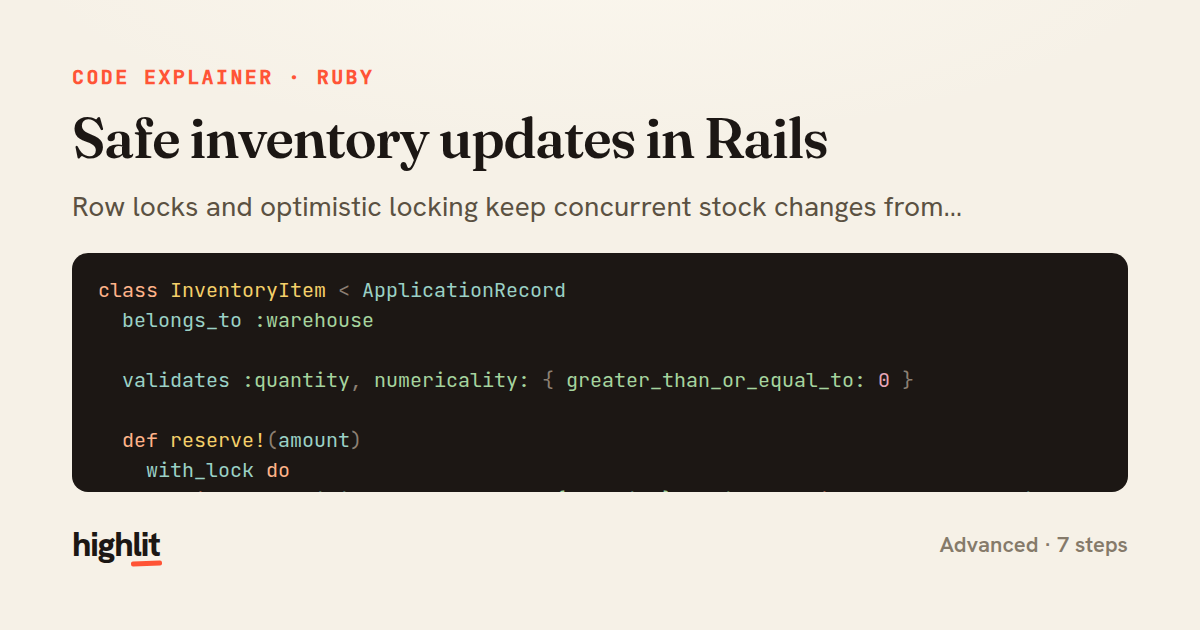
Safe inventory updates in Rails
Row locks and optimistic locking keep concurrent stock changes from corrupting each other.
Explained by
highlit
1class InventoryItem < ApplicationRecord
2 belongs_to :warehouse
3
4 validates :quantity, numericality: { greater_than_or_equal_to: 0 }
5
6 def reserve!(amount)
7 with_lock do
8 raise InsufficientStock, "only #{quantity} available" if amount > quantity
9
10 update!(quantity: quantity - amount, reserved_at: Time.current)
11 end
12 end
13end
14
15class InventoryItemsController < ApplicationController
16 before_action :set_item
17
18 def update
19 @item.assign_attributes(item_params)
20
21 if @item.save
22 redirect_to @item, notice: "Inventory updated."
23 else
24 render :edit, status: :unprocessable_entity
25 end
26 rescue ActiveRecord::StaleObjectError
27 @item.reload
28 flash.now[:alert] =
29 "This item was changed by someone else while you were editing. " \
30 "Review the latest values and try again."
31 render :edit, status: :conflict
32 end
33
34 private
35
36 def set_item
37 @item = InventoryItem.find(params[:id])
38 end
39
40 def item_params
41 params.require(:inventory_item).permit(:quantity, :sku, :bin_location, :lock_version)
42 end
43end
01 / 01
STEP 01
‹ swipe to step through ›
Walkthrough
Space play
←→ step
click any line
Three takeaways
- 1Wrap read-then-write logic in a database lock so two requests can't act on stale quantities.
- 2Optimistic locking lets edits proceed unblocked but rejects saves that raced against a concurrent change.
- 3Turn concurrency conflicts into clear, actionable feedback instead of silent data loss.
Related explainers
rust
use serde::Deserialize;

#[derive(Debug, Deserialize)]
#[serde(untagged)]
Parsing flexible JSON shapes with serde
deserialization
enums
json
Intermediate
6 steps
ruby
require "shellwords"
require "open3"

module Backup
Building safe shell commands in Ruby
shell-out
subprocess
command-injection
Intermediate
7 steps
ruby
class UserAgentParser
  BROWSERS = [
    [/Edg\/([\d.]+)/, "Edge"],
    [/OPR\/([\d.]+)/, "Opera"],
Parsing user-agent strings in Ruby
regex
pattern-matching
lookup-tables
Intermediate
8 steps
ruby
class LogAggregator
  BUCKET_FORMAT = "%Y-%m-%dT%H:%M"

  def initialize(entries)
Bucketing log entries by the minute in Ruby
aggregation
hashing
enumerable
Intermediate
5 steps
go
func (w *Watcher) resetDebounce(d time.Duration) {
	if !w.timer.Stop() {
		select {
		case <-w.timer.C:
Debouncing a stream of events in Go
debounce
timers
channels
Advanced
7 steps
ruby
class WeeklySignupsReport
  DEFAULT_WEEKS = 12

  def initialize(weeks: DEFAULT_WEEKS, source: User.all)
Building a weekly signups report in Rails
service object
aggregation
group by
Intermediate
7 steps
Share this explainer
Here's the card — post it anywhere.
Made with highlit — turn any snippet into a walkthrough like this in about a minute.
Explain your code
Embed this explainer
Drop the interactive walkthrough into a blog or docs. Views never cost a credit.
<iframe src="https://highlit.co/explainers/safe-inventory-updates-in-rails-explained-ruby-5380/embed?autoplay=1" width="100%" height="520" loading="lazy" style="border:0"></iframe>
Autoplay is on by default — add ?autoplay=0 to start paused.