javascript
36 lines · 8 steps
Uploading records with bounded concurrency
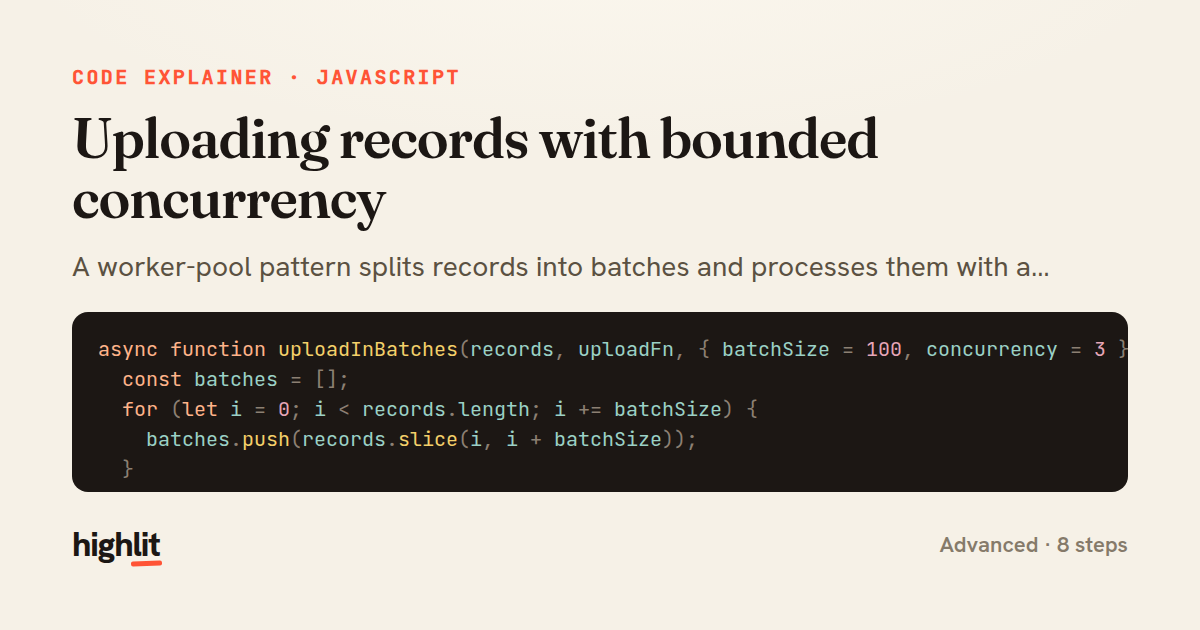
A worker-pool pattern splits records into batches and processes them with a capped number of concurrent uploads.
Explained by
highlit
1async function uploadInBatches(records, uploadFn, { batchSize = 100, concurrency = 3 } = {}) {
2 const batches = [];
3 for (let i = 0; i < records.length; i += batchSize) {
4 batches.push(records.slice(i, i + batchSize));
5 }
6
7 const results = [];
8 let cursor = 0;
9
10 async function worker() {
11 while (cursor < batches.length) {
12 const index = cursor++;
13 const batch = batches[index];
14 try {
15 const response = await uploadFn(batch, index);
16 results[index] = { status: 'fulfilled', count: batch.length, response };
17 } catch (error) {
18 results[index] = { status: 'rejected', count: batch.length, error };
19 }
20 }
21 }
22
23 const workers = Array.from(
24 { length: Math.min(concurrency, batches.length) },
25 () => worker()
26 );
27 await Promise.all(workers);
28
29 const failed = results.filter((r) => r.status === 'rejected');
30 return {
31 total: records.length,
32 batches: batches.length,
33 uploaded: results.reduce((sum, r) => sum + (r.status === 'fulfilled' ? r.count : 0), 0),
34 failed,
35 };
36}
01 / 01
STEP 01
‹ swipe to step through ›
Walkthrough
Space play
←→ step
click any line
Three takeaways
- 1A shared cursor lets a fixed set of workers pull the next task without exceeding a concurrency cap.
- 2Catching errors per task and recording their status keeps one failure from aborting the whole run.
- 3Writing results by index preserves ordering even when tasks finish out of order.
Related explainers
rust
use serde::Deserialize;

#[derive(Debug, Deserialize)]
#[serde(untagged)]
Parsing flexible JSON shapes with serde
deserialization
enums
json
Intermediate
6 steps
ruby
require "shellwords"
require "open3"

module Backup
Building safe shell commands in Ruby
shell-out
subprocess
command-injection
Intermediate
7 steps
javascript
function evaluate(expression) {
  const tokens = tokenize(expression);
  let pos = 0;
Building a recursive descent calculator
parsing
recursion
operator-precedence
Intermediate
8 steps
javascript
import { useState, useEffect, useCallback, useRef } from 'react';

const cache = new Map();
const inflight = new Map();
Building a stale-while-revalidate hook in React
caching
request-deduplication
custom-hooks
Advanced
10 steps
go
func (w *Watcher) resetDebounce(d time.Duration) {
	if !w.timer.Stop() {
		select {
		case <-w.timer.C:
Debouncing a stream of events in Go
debounce
timers
channels
Advanced
7 steps
rust
use chrono::{Duration, NaiveDate};

#[derive(Debug)]
pub struct DateRange {
Parsing and iterating date ranges in Rust
error-handling
iterators
parsing
Intermediate
7 steps
Share this explainer
Here's the card — post it anywhere.
Made with highlit — turn any snippet into a walkthrough like this in about a minute.
Explain your code
Embed this explainer
Drop the interactive walkthrough into a blog or docs. Views never cost a credit.
<iframe src="https://highlit.co/explainers/uploading-records-with-bounded-concurrency-explained-javascript-1ac4/embed?autoplay=1" width="100%" height="520" loading="lazy" style="border:0"></iframe>
Autoplay is on by default — add ?autoplay=0 to start paused.