ruby
51 lines · 9 steps
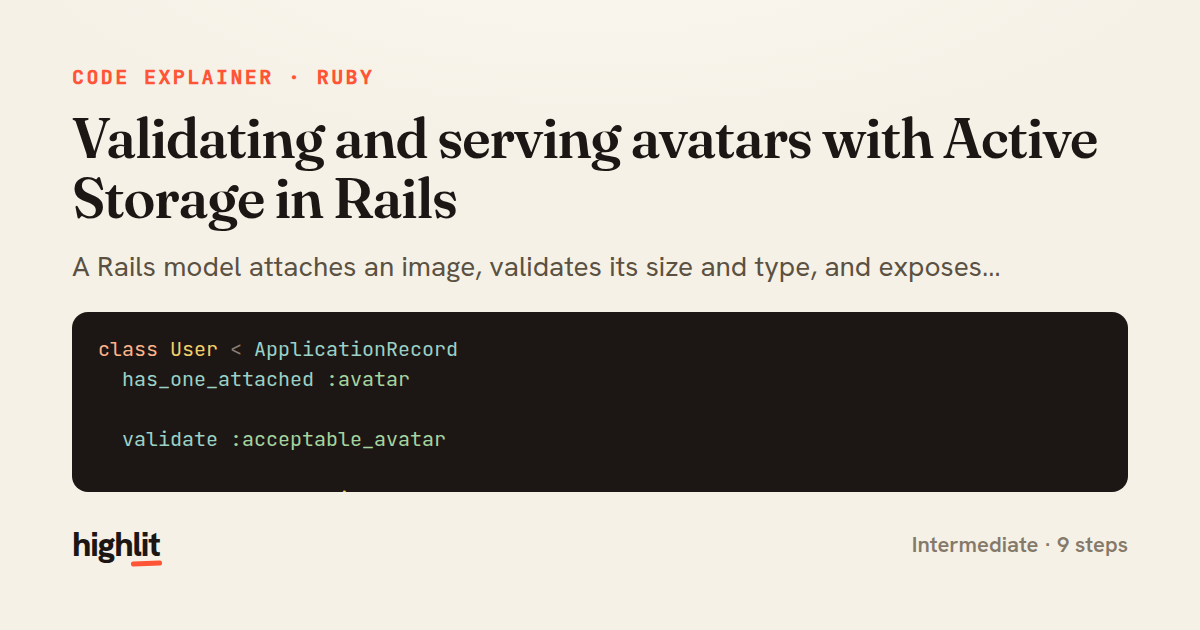
Validating and serving avatars with Active Storage in Rails
A Rails model attaches an image, validates its size and type, and exposes processed variants while a controller handles upload and removal.
Explained by
highlit
1class User < ApplicationRecord
2 has_one_attached :avatar
3
4 validate :acceptable_avatar
5
6 def avatar_thumbnail
7 avatar.variant(resize_to_fill: [100, 100], format: :webp).processed
8 end
9
10 def avatar_medium
11 avatar.variant(resize_to_limit: [400, 400], format: :webp, saver: { quality: 80 }).processed
12 end
13
14 private
15
16 def acceptable_avatar
17 return unless avatar.attached?
18
19 unless avatar.blob.byte_size <= 5.megabytes
20 errors.add(:avatar, "is too big (maximum is 5MB)")
21 end
22
23 acceptable_types = %w[image/png image/jpeg image/webp]
24 unless acceptable_types.include?(avatar.blob.content_type)
25 errors.add(:avatar, "must be a PNG, JPEG, or WebP")
26 end
27 end
28end
29
30class AvatarsController < ApplicationController
31 before_action :authenticate_user!
32
33 def update
34 if current_user.update(avatar_params)
35 redirect_to edit_profile_path, notice: "Avatar updated."
36 else
37 render "profiles/edit", status: :unprocessable_entity
38 end
39 end
40
41 def destroy
42 current_user.avatar.purge_later
43 redirect_to edit_profile_path, notice: "Avatar removed."
44 end
45
46 private
47
48 def avatar_params
49 params.require(:user).permit(:avatar)
50 end
51end
01 / 01
STEP 01
‹ swipe to step through ›
Walkthrough
Space play
←→ step
click any line
Three takeaways
- 1Active Storage attachments need explicit validations since the framework won't enforce size or content type for you.
- 2Defining variants as model methods keeps image-processing rules in one place and reusable across views.
- 3Use purge_later to remove blobs asynchronously rather than blocking the request on deletion.
Related explainers
ruby
require "shellwords"
require "open3"

module Backup
Building safe shell commands in Ruby
shell-out
subprocess
command-injection
Intermediate
7 steps
php
<?php

namespace App\Services\Checkout;
Validating coupons with Laravel's Pipeline
pipeline
chain of responsibility
transactions
Intermediate
7 steps
ruby
class UserAgentParser
  BROWSERS = [
    [/Edg\/([\d.]+)/, "Edge"],
    [/OPR\/([\d.]+)/, "Opera"],
Parsing user-agent strings in Ruby
regex
pattern-matching
lookup-tables
Intermediate
8 steps
php
<?php

namespace App\Services;
How a password strength validator works in PHP
validation
regular-expressions
data-driven
Intermediate
8 steps
ruby
class LogAggregator
  BUCKET_FORMAT = "%Y-%m-%dT%H:%M"

  def initialize(entries)
Bucketing log entries by the minute in Ruby
aggregation
hashing
enumerable
Intermediate
5 steps
ruby
class WeeklySignupsReport
  DEFAULT_WEEKS = 12

  def initialize(weeks: DEFAULT_WEEKS, source: User.all)
Building a weekly signups report in Rails
service object
aggregation
group by
Intermediate
7 steps
Share this explainer
Here's the card — post it anywhere.
Made with highlit — turn any snippet into a walkthrough like this in about a minute.
Explain your code
Embed this explainer
Drop the interactive walkthrough into a blog or docs. Views never cost a credit.
<iframe src="https://highlit.co/explainers/validating-and-serving-avatars-with-active-storage-in-rails-explained-ruby-ea16/embed?autoplay=1" width="100%" height="520" loading="lazy" style="border:0"></iframe>
Autoplay is on by default — add ?autoplay=0 to start paused.