java
44 lines · 8 steps
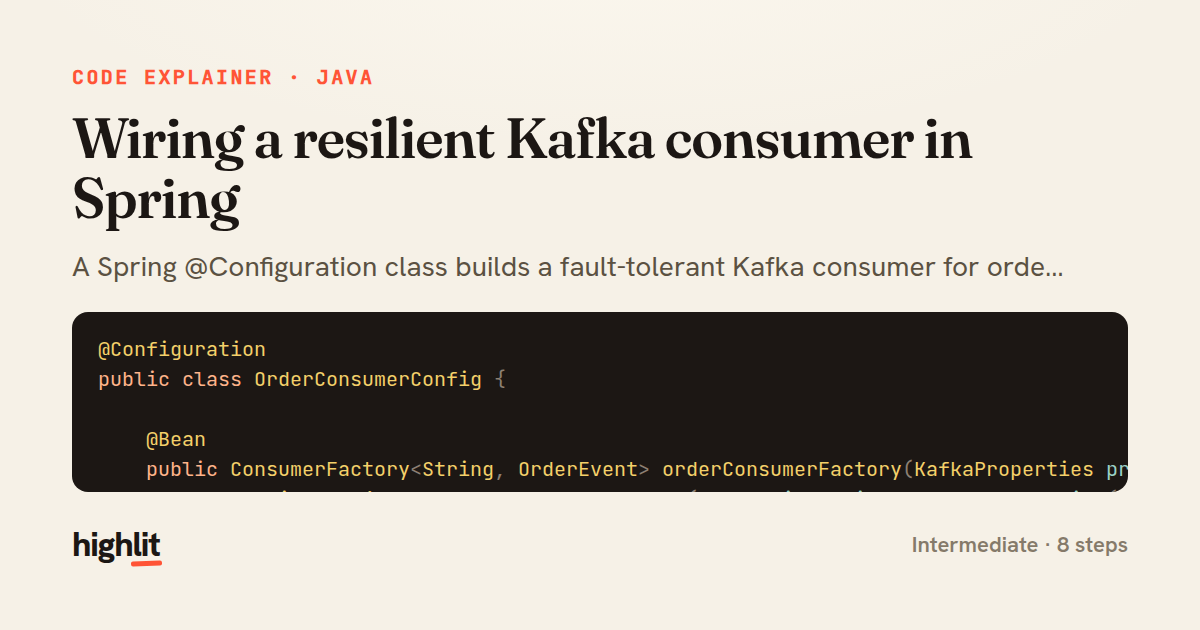
Wiring a resilient Kafka consumer in Spring
A Spring @Configuration class builds a fault-tolerant Kafka consumer for order events with JSON deserialization and safe error handling.
Explained by
highlit
1@Configuration
2public class OrderConsumerConfig {
3
4 @Bean
5 public ConsumerFactory<String, OrderEvent> orderConsumerFactory(KafkaProperties properties) {
6 Map<String, Object> props = new HashMap<>(properties.buildConsumerProperties());
7 props.put(ConsumerConfig.GROUP_ID_CONFIG, "order-processing");
8 props.put(ConsumerConfig.AUTO_OFFSET_RESET_CONFIG, "earliest");
9 props.put(ConsumerConfig.KEY_DESERIALIZER_CLASS_CONFIG, StringDeserializer.class);
10 props.put(ConsumerConfig.VALUE_DESERIALIZER_CLASS_CONFIG, ErrorHandlingDeserializer.class);
11 props.put(ErrorHandlingDeserializer.VALUE_DESERIALIZER_CLASS, JsonDeserializer.class);
12
13 JsonDeserializer<OrderEvent> valueDeserializer = new JsonDeserializer<>(OrderEvent.class);
14 valueDeserializer.setRemoveTypeHeaders(false);
15 valueDeserializer.addTrustedPackages("com.acme.orders.events");
16
17 return new DefaultKafkaConsumerFactory<>(
18 props,
19 new StringDeserializer(),
20 new ErrorHandlingDeserializer<>(valueDeserializer));
21 }
22
23 @Bean
24 public ConcurrentKafkaListenerContainerFactory<String, OrderEvent> orderKafkaListenerContainerFactory(
25 ConsumerFactory<String, OrderEvent> orderConsumerFactory) {
26 ConcurrentKafkaListenerContainerFactory<String, OrderEvent> factory =
27 new ConcurrentKafkaListenerContainerFactory<>();
28 factory.setConsumerFactory(orderConsumerFactory);
29 factory.setConcurrency(3);
30 return factory;
31 }
32
33 @KafkaListener(
34 topics = "orders.placed",
35 groupId = "order-processing",
36 containerFactory = "orderKafkaListenerContainerFactory")
37 public void onOrderPlaced(
38 @Payload OrderEvent event,
39 @Header(KafkaHeaders.RECEIVED_PARTITION) int partition,
40 @Header(KafkaHeaders.RECEIVED_KEY) String key) {
41 log.info("Received order {} from partition {}", event.orderId(), partition);
42 orderService.process(event);
43 }
44}
01 / 01
STEP 01
‹ swipe to step through ›
Walkthrough
Space play
←→ step
click any line
Three takeaways
- 1Wrapping a deserializer in ErrorHandlingDeserializer stops one poison message from crashing the whole consumer.
- 2Trusted packages must be declared explicitly so the JSON deserializer only instantiates types you control.
- 3Container concurrency lets a single listener method process multiple partitions in parallel.
Related explainers
rust
use serde::Deserialize;

#[derive(Debug, Deserialize)]
#[serde(untagged)]
Parsing flexible JSON shapes with serde
deserialization
enums
json
Intermediate
6 steps
ruby
require "shellwords"
require "open3"

module Backup
Building safe shell commands in Ruby
shell-out
subprocess
command-injection
Intermediate
7 steps
typescript
import { Module } from '@nestjs/common';
import { ConfigModule } from '@nestjs/config';
import * as Joi from 'joi';
Validating env config at boot in NestJS
configuration
schema-validation
environment-variables
Intermediate
8 steps
java
@Component
@Converter
public class EncryptedStringConverter implements AttributeConverter<String, String> {
Transparent column encryption in Spring & JPA
encryption
aes-gcm
jpa-converter
Advanced
10 steps
java
package com.acme.billing.config;

import org.springframework.boot.autoconfigure.condition.ConditionalOnProperty;
import org.springframework.boot.context.properties.ConfigurationProperties;
Feature-flagged beans with Spring @ConditionalOnProperty
feature-flags
conditional-beans
strategy-pattern
Intermediate
5 steps
rust
use chrono::{Duration, NaiveDate};

#[derive(Debug)]
pub struct DateRange {
Parsing and iterating date ranges in Rust
error-handling
iterators
parsing
Intermediate
7 steps
Share this explainer
Here's the card — post it anywhere.
Made with highlit — turn any snippet into a walkthrough like this in about a minute.
Explain your code
Embed this explainer
Drop the interactive walkthrough into a blog or docs. Views never cost a credit.
<iframe src="https://highlit.co/explainers/wiring-a-resilient-kafka-consumer-in-spring-explained-java-f062/embed?autoplay=1" width="100%" height="520" loading="lazy" style="border:0"></iframe>
Autoplay is on by default — add ?autoplay=0 to start paused.