python
34 lines · 8 steps
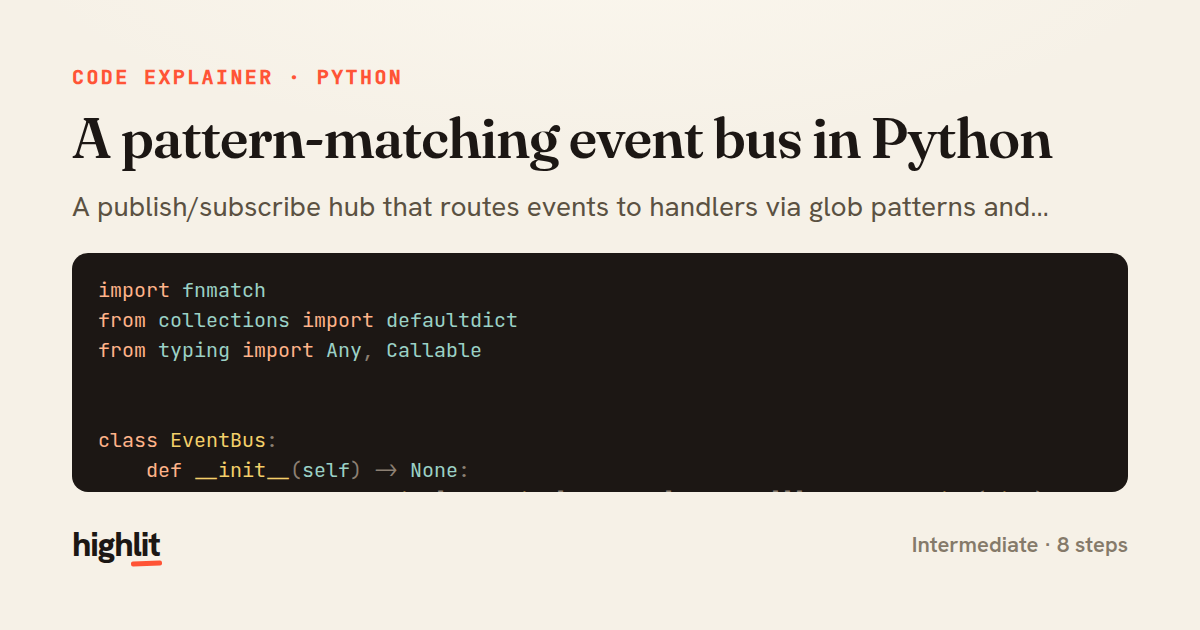
A pattern-matching event bus in Python
A publish/subscribe hub that routes events to handlers via glob patterns and doubles as a decorator.
Explained by
highlit
1import fnmatch
2from collections import defaultdict
3from typing import Any, Callable
4
5
6class EventBus:
7 def __init__(self) -> None:
8 self._handlers: dict[str, list[Callable[..., Any]]] = defaultdict(list)
9
10 def subscribe(self, pattern: str, handler: Callable[..., Any] | None = None):
11 if handler is None:
12 def decorator(fn: Callable[..., Any]) -> Callable[..., Any]:
13 self._handlers[pattern].append(fn)
14 return fn
15 return decorator
16 self._handlers[pattern].append(handler)
17 return handler
18
19 def unsubscribe(self, pattern: str, handler: Callable[..., Any]) -> None:
20 listeners = self._handlers.get(pattern)
21 if listeners and handler in listeners:
22 listeners.remove(handler)
23 if not listeners:
24 del self._handlers[pattern]
25
26 def publish(self, event: str, *args: Any, **kwargs: Any) -> int:
27 delivered = 0
28 for pattern, listeners in list(self._handlers.items()):
29 if not fnmatch.fnmatchcase(event, pattern):
30 continue
31 for handler in list(listeners):
32 handler(event, *args, **kwargs)
33 delivered += 1
34 return delivered
01 / 01
STEP 01
‹ swipe to step through ›
Walkthrough
Space play
←→ step
click any line
Three takeaways
- 1A defaultdict of lists lets you register handlers under a key without existence checks.
- 2Making the handler argument optional turns one method into both a direct call and a decorator.
- 3Iterating over copies of mutable collections keeps publish safe against handlers that subscribe or unsubscribe mid-dispatch.
Related explainers
python
from fastapi import FastAPI, WebSocket, WebSocketDisconnect

app = FastAPI()
Building a WebSocket chat with FastAPI
websockets
broadcast
connection-management
Intermediate
9 steps
ruby
class UserAgentParser
  BROWSERS = [
    [/Edg\/([\d.]+)/, "Edge"],
    [/OPR\/([\d.]+)/, "Opera"],
Parsing user-agent strings in Ruby
regex
pattern-matching
lookup-tables
Intermediate
8 steps
python
import time
import uuid

from django.utils.deprecation import MiddlewareMixin
Attaching per-request context in Django
middleware
request lifecycle
multi-tenancy
Intermediate
7 steps
python
import random
from typing import Iterator, List
How reservoir sampling picks k items
reservoir-sampling
streaming
randomness
Intermediate
5 steps
python
import secrets

from django.contrib.auth import authenticate, login
from django.core.cache import cache
Two-factor login with OTP in Django
two-factor-auth
one-time-passwords
caching
Intermediate
9 steps
python
import re
from functools import total_ordering
from typing import Optional
Parsing and comparing semantic versions
regex
operator-overloading
sorting
Intermediate
7 steps
Share this explainer
Here's the card — post it anywhere.
Made with highlit — turn any snippet into a walkthrough like this in about a minute.
Explain your code
Embed this explainer
Drop the interactive walkthrough into a blog or docs. Views never cost a credit.
<iframe src="https://highlit.co/explainers/a-pattern-matching-event-bus-in-python-explained-python-c520/embed?autoplay=1" width="100%" height="520" loading="lazy" style="border:0"></iframe>
Autoplay is on by default — add ?autoplay=0 to start paused.