python
36 lines · 8 steps
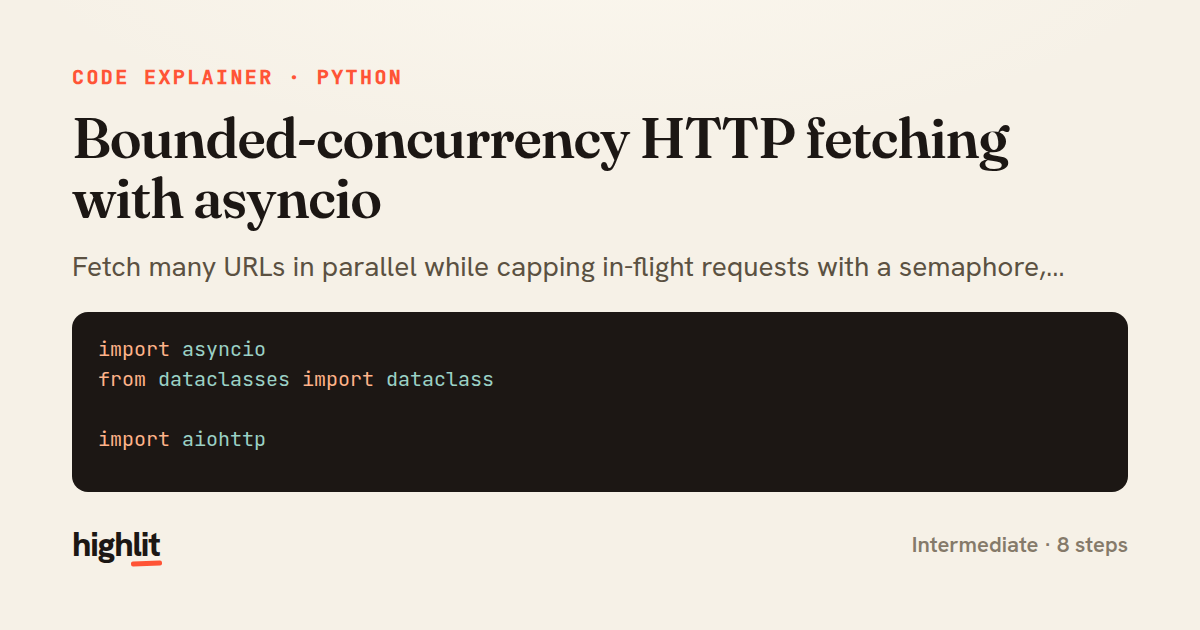
Bounded-concurrency HTTP fetching with asyncio
Fetch many URLs in parallel while capping in-flight requests with a semaphore, returning a structured result for each.
Explained by
highlit
1import asyncio
2from dataclasses import dataclass
3
4import aiohttp
5
6
7@dataclass
8class FetchResult:
9 url: str
10 status: int | None
11 body: str | None
12 error: str | None = None
13
14
15async def fetch_one(
16 session: aiohttp.ClientSession,
17 semaphore: asyncio.Semaphore,
18 url: str,
19 timeout: float = 10.0,
20) -> FetchResult:
21 async with semaphore:
22 try:
23 async with session.get(url, timeout=aiohttp.ClientTimeout(total=timeout)) as resp:
24 return FetchResult(url=url, status=resp.status, body=await resp.text())
25 except (aiohttp.ClientError, asyncio.TimeoutError) as exc:
26 return FetchResult(url=url, status=None, body=None, error=str(exc))
27
28
29async def fetch_all(urls: list[str], max_concurrency: int = 8) -> list[FetchResult]:
30 semaphore = asyncio.Semaphore(max_concurrency)
31 async with aiohttp.ClientSession() as session:
32 tasks = [
33 asyncio.create_task(fetch_one(session, semaphore, url))
34 for url in urls
35 ]
36 return await asyncio.gather(*tasks)
01 / 01
STEP 01
‹ swipe to step through ›
Walkthrough
Space play
←→ step
click any line
Three takeaways
- 1A shared asyncio.Semaphore caps how many coroutines run their critical section at once, throttling concurrency without blocking the loop.
- 2Returning a result object per URL instead of raising lets partial failures coexist with successes in a single gathered list.
- 3Reusing one ClientSession across all requests amortizes connection pooling and TLS setup for every fetch.
Related explainers
rust
use serde::Deserialize;

#[derive(Debug, Deserialize)]
#[serde(untagged)]
Parsing flexible JSON shapes with serde
deserialization
enums
json
Intermediate
6 steps
ruby
require "shellwords"
require "open3"

module Backup
Building safe shell commands in Ruby
shell-out
subprocess
command-injection
Intermediate
7 steps
python
from fastapi import FastAPI, WebSocket, WebSocketDisconnect

app = FastAPI()
Building a WebSocket chat with FastAPI
websockets
broadcast
connection-management
Intermediate
9 steps
python
import time
import uuid

from django.utils.deprecation import MiddlewareMixin
Attaching per-request context in Django
middleware
request lifecycle
multi-tenancy
Intermediate
7 steps
rust
use axum::{
    extract::{Path, State},
    response::sse::{Event, KeepAlive, Sse},
};
Streaming import progress with SSE in Axum
server-sent-events
streams
watch-channel
Advanced
7 steps
javascript
import { useState, useEffect, useCallback, useRef } from 'react';

const cache = new Map();
const inflight = new Map();
Building a stale-while-revalidate hook in React
caching
request-deduplication
custom-hooks
Advanced
10 steps
Share this explainer
Here's the card — post it anywhere.
Made with highlit — turn any snippet into a walkthrough like this in about a minute.
Explain your code
Embed this explainer
Drop the interactive walkthrough into a blog or docs. Views never cost a credit.
<iframe src="https://highlit.co/explainers/bounded-concurrency-http-fetching-with-asyncio-explained-python-e616/embed?autoplay=1" width="100%" height="520" loading="lazy" style="border:0"></iframe>
Autoplay is on by default — add ?autoplay=0 to start paused.