python
41 lines · 9 steps
Building a fuzzy autocomplete matcher
A FuzzyMatcher blends prefix binary search with similarity scoring to rank suggestions for a query.
Explained by
highlit
1from difflib import SequenceMatcher
2from bisect import bisect_left, bisect_right
3
4
5class FuzzyMatcher:
6 def __init__(self, candidates, min_score=0.45):
7 self._items = sorted(set(candidates), key=str.lower)
8 self._lowered = [c.lower() for c in self._items]
9 self.min_score = min_score
10
11 def _prefix_window(self, query):
12 lo = bisect_left(self._lowered, query)
13 hi = bisect_right(self._lowered, query + "\uffff")
14 return set(range(lo, hi))
15
16 def _score(self, query, candidate):
17 matcher = SequenceMatcher(None, query, candidate)
18 ratio = matcher.ratio()
19 if candidate.startswith(query):
20 ratio += 0.35
21 elif query in candidate:
22 ratio += 0.15
23 length_penalty = min(len(candidate), 30) / 300
24 return min(ratio - length_penalty, 1.0)
25
26 def suggest(self, query, limit=8):
27 query = query.strip().lower()
28 if not query:
29 return []
30
31 prefix_hits = self._prefix_window(query)
32 scored = []
33 for idx, candidate in enumerate(self._lowered):
34 if not prefix_hits and SequenceMatcher(None, query, candidate).quick_ratio() < self.min_score:
35 continue
36 score = self._score(query, candidate)
37 if idx in prefix_hits or score >= self.min_score:
38 scored.append((score, self._items[idx]))
39
40 scored.sort(key=lambda pair: (-pair[0], pair[1].lower()))
41 return [item for _, item in scored[:limit]]
01 / 01
STEP 01
‹ swipe to step through ›
Walkthrough
Space play
←→ step
click any line
Three takeaways
- 1Precomputing a sorted, lowercased index lets you binary-search a prefix window in log time.
- 2Combining a similarity ratio with prefix bonuses and a length penalty produces more intuitive rankings than raw ratios.
- 3A cheap quick_ratio filter prunes weak candidates before the more expensive full score runs.
Related explainers
python
from fastapi import FastAPI, WebSocket, WebSocketDisconnect

app = FastAPI()
Building a WebSocket chat with FastAPI
websockets
broadcast
connection-management
Intermediate
9 steps
python
import time
import uuid

from django.utils.deprecation import MiddlewareMixin
Attaching per-request context in Django
middleware
request lifecycle
multi-tenancy
Intermediate
7 steps
python
import random
from typing import Iterator, List
How reservoir sampling picks k items
reservoir-sampling
streaming
randomness
Intermediate
5 steps
python
import secrets

from django.contrib.auth import authenticate, login
from django.core.cache import cache
Two-factor login with OTP in Django
two-factor-auth
one-time-passwords
caching
Intermediate
9 steps
python
import re
from functools import total_ordering
from typing import Optional
Parsing and comparing semantic versions
regex
operator-overloading
sorting
Intermediate
7 steps
python
from typing import Any, Sequence, Mapping


def render_markdown_table(
Rendering an aligned Markdown table in Python
string formatting
data transformation
closures
Intermediate
8 steps
Share this explainer
Here's the card — post it anywhere.
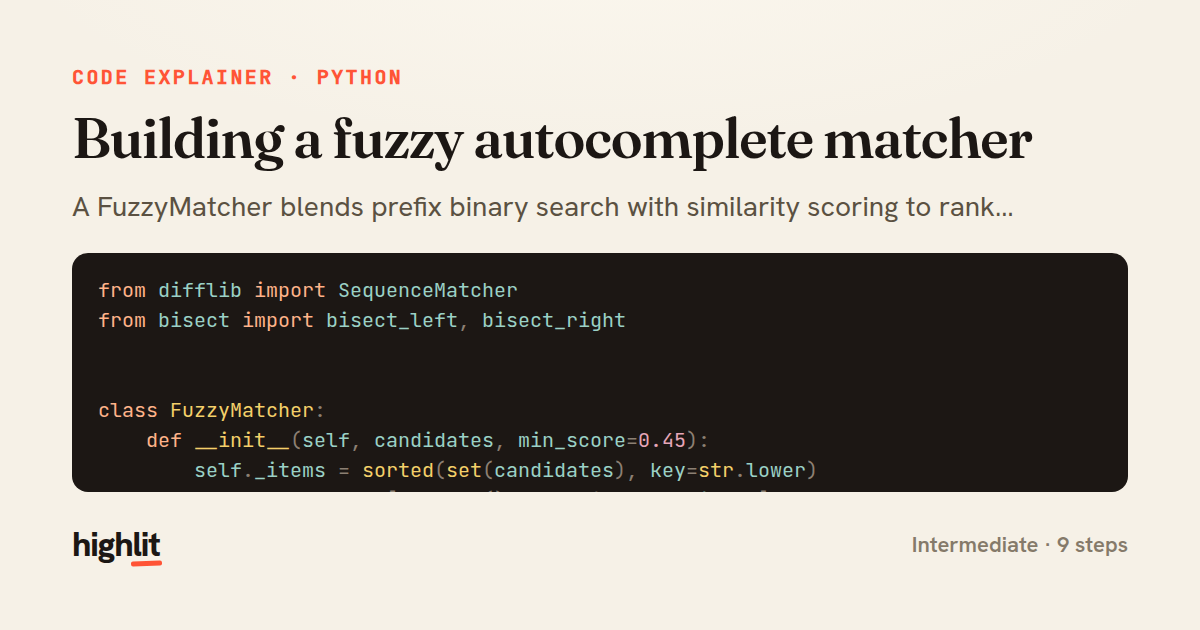
Made with highlit — turn any snippet into a walkthrough like this in about a minute.
Explain your code
Embed this explainer
Drop the interactive walkthrough into a blog or docs. Views never cost a credit.
<iframe src="https://highlit.co/explainers/building-a-fuzzy-autocomplete-matcher-explained-python-3657/embed?autoplay=1" width="100%" height="520" loading="lazy" style="border:0"></iframe>
Autoplay is on by default — add ?autoplay=0 to start paused.