python
48 lines · 7 steps
Building a prefix trie in Python
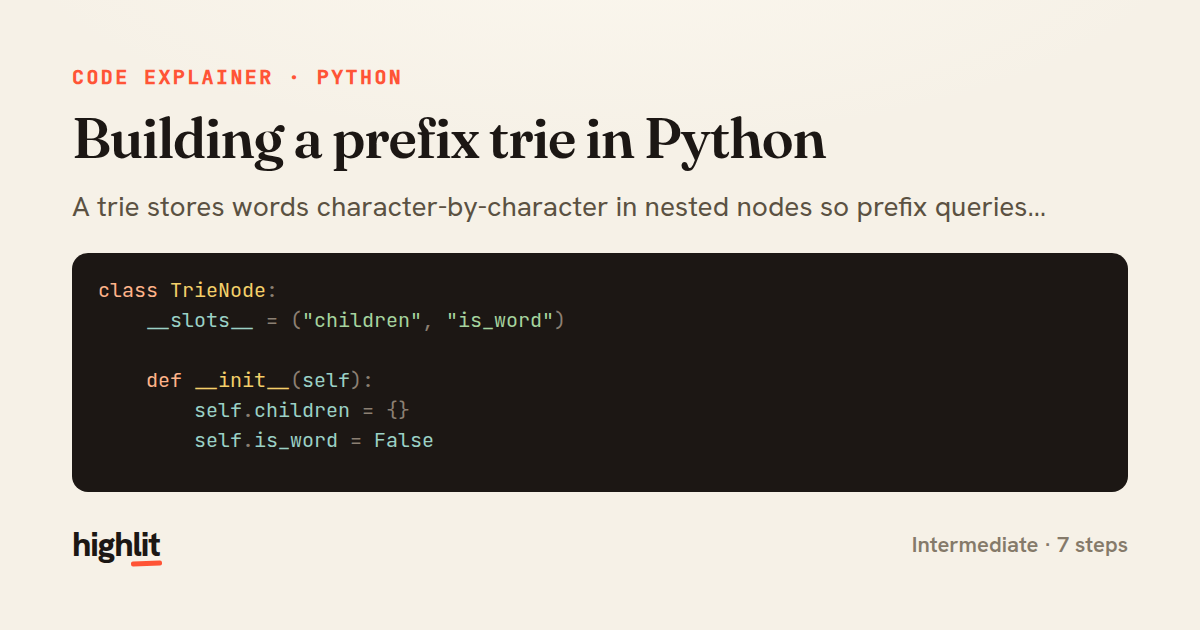
A trie stores words character-by-character in nested nodes so prefix queries and autocomplete become simple tree walks.
Explained by
highlit
1class TrieNode:
2 __slots__ = ("children", "is_word")
3
4 def __init__(self):
5 self.children = {}
6 self.is_word = False
7
8
9class Trie:
10 def __init__(self, words=None):
11 self.root = TrieNode()
12 for word in words or ():
13 self.insert(word)
14
15 def insert(self, word):
16 node = self.root
17 for char in word:
18 node = node.children.setdefault(char, TrieNode())
19 node.is_word = True
20
21 def contains(self, word):
22 node = self._find(word)
23 return node is not None and node.is_word
24
25 def starts_with(self, prefix):
26 return self._find(prefix) is not None
27
28 def words_with_prefix(self, prefix):
29 node = self._find(prefix)
30 if node is None:
31 return []
32 results = []
33 self._collect(node, prefix, results)
34 return results
35
36 def _find(self, prefix):
37 node = self.root
38 for char in prefix:
39 node = node.children.get(char)
40 if node is None:
41 return None
42 return node
43
44 def _collect(self, node, prefix, results):
45 if node.is_word:
46 results.append(prefix)
47 for char, child in node.children.items():
48 self._collect(child, prefix + char, results)
01 / 01
STEP 01
‹ swipe to step through ›
Walkthrough
Space play
←→ step
click any line
Three takeaways
- 1A trie shares common prefixes across words, making prefix lookups proportional to word length rather than dictionary size.
- 2Factoring the shared descent into a private _find helper keeps contains, starts_with, and autocomplete tiny and consistent.
- 3Recursive collection with an accumulator naturally enumerates every word under a subtree for autocomplete.
Related explainers
python
from fastapi import FastAPI, WebSocket, WebSocketDisconnect

app = FastAPI()
Building a WebSocket chat with FastAPI
websockets
broadcast
connection-management
Intermediate
9 steps
python
import time
import uuid

from django.utils.deprecation import MiddlewareMixin
Attaching per-request context in Django
middleware
request lifecycle
multi-tenancy
Intermediate
7 steps
javascript
function evaluate(expression) {
  const tokens = tokenize(expression);
  let pos = 0;
Building a recursive descent calculator
parsing
recursion
operator-precedence
Intermediate
8 steps
python
import random
from typing import Iterator, List
How reservoir sampling picks k items
reservoir-sampling
streaming
randomness
Intermediate
5 steps
python
import secrets

from django.contrib.auth import authenticate, login
from django.core.cache import cache
Two-factor login with OTP in Django
two-factor-auth
one-time-passwords
caching
Intermediate
9 steps
python
import re
from functools import total_ordering
from typing import Optional
Parsing and comparing semantic versions
regex
operator-overloading
sorting
Intermediate
7 steps
Share this explainer
Here's the card — post it anywhere.
Made with highlit — turn any snippet into a walkthrough like this in about a minute.
Explain your code
Embed this explainer
Drop the interactive walkthrough into a blog or docs. Views never cost a credit.
<iframe src="https://highlit.co/explainers/building-a-prefix-trie-in-python-explained-python-2727/embed?autoplay=1" width="100%" height="520" loading="lazy" style="border:0"></iframe>
Autoplay is on by default — add ?autoplay=0 to start paused.