rust
51 lines · 9 steps
Building a typed error enum in Rust
A custom enum models every validation failure as a distinct, self-describing error variant.
Explained by
highlit
1use std::error::Error;
2use std::fmt;
3
4#[derive(Debug)]
5pub enum ValidationError {
6 EmptyUsername,
7 UsernameTooLong { len: usize, max: usize },
8 InvalidEmail(String),
9 WeakPassword { reason: &'static str },
10}
11
12impl fmt::Display for ValidationError {
13 fn fmt(&self, f: &mut fmt::Formatter<'_>) -> fmt::Result {
14 match self {
15 ValidationError::EmptyUsername => write!(f, "username must not be empty"),
16 ValidationError::UsernameTooLong { len, max } => {
17 write!(f, "username is {len} characters, but the maximum is {max}")
18 }
19 ValidationError::InvalidEmail(email) => write!(f, "'{email}' is not a valid email address"),
20 ValidationError::WeakPassword { reason } => write!(f, "password is too weak: {reason}"),
21 }
22 }
23}
24
25impl Error for ValidationError {}
26
27pub struct Registration {
28 pub username: String,
29 pub email: String,
30 pub password: String,
31}
32
33pub fn validate(input: &Registration) -> Result<(), ValidationError> {
34 let name = input.username.trim();
35 if name.is_empty() {
36 return Err(ValidationError::EmptyUsername);
37 }
38 if name.len() > 32 {
39 return Err(ValidationError::UsernameTooLong { len: name.len(), max: 32 });
40 }
41 if !input.email.contains('@') || !input.email.contains('.') {
42 return Err(ValidationError::InvalidEmail(input.email.clone()));
43 }
44 if input.password.len() < 8 {
45 return Err(ValidationError::WeakPassword { reason: "must be at least 8 characters" });
46 }
47 if !input.password.chars().any(|c| c.is_ascii_digit()) {
48 return Err(ValidationError::WeakPassword { reason: "must contain a digit" });
49 }
50 Ok(())
51}
01 / 01
STEP 01
‹ swipe to step through ›
Walkthrough
Space play
←→ step
click any line
Three takeaways
- 1Modeling each failure mode as an enum variant lets the compiler enforce exhaustive handling of every error case.
- 2Implementing Display plus the Error marker trait makes your type interoperate with the standard error ecosystem.
- 3Returning Result with a rich error type pushes failure details to the caller instead of losing them in strings.
Related explainers
rust
use serde::Deserialize;

#[derive(Debug, Deserialize)]
#[serde(untagged)]
Parsing flexible JSON shapes with serde
deserialization
enums
json
Intermediate
6 steps
ruby
require "shellwords"
require "open3"

module Backup
Building safe shell commands in Ruby
shell-out
subprocess
command-injection
Intermediate
7 steps
php
<?php

namespace App\Services\Checkout;
Validating coupons with Laravel's Pipeline
pipeline
chain of responsibility
transactions
Intermediate
7 steps
rust
use std::cmp::{Ordering, Reverse};
use std::collections::BinaryHeap;
use std::fs::File;
use std::io::{self, BufRead, BufReader, BufWriter, Lines, Write};
K-way merge of sorted logs in Rust
binary-heap
k-way-merge
streaming-io
Intermediate
8 steps
ruby
class UserAgentParser
  BROWSERS = [
    [/Edg\/([\d.]+)/, "Edge"],
    [/OPR\/([\d.]+)/, "Opera"],
Parsing user-agent strings in Ruby
regex
pattern-matching
lookup-tables
Intermediate
8 steps
php
<?php

namespace App\Services;
How a password strength validator works in PHP
validation
regular-expressions
data-driven
Intermediate
8 steps
Share this explainer
Here's the card — post it anywhere.
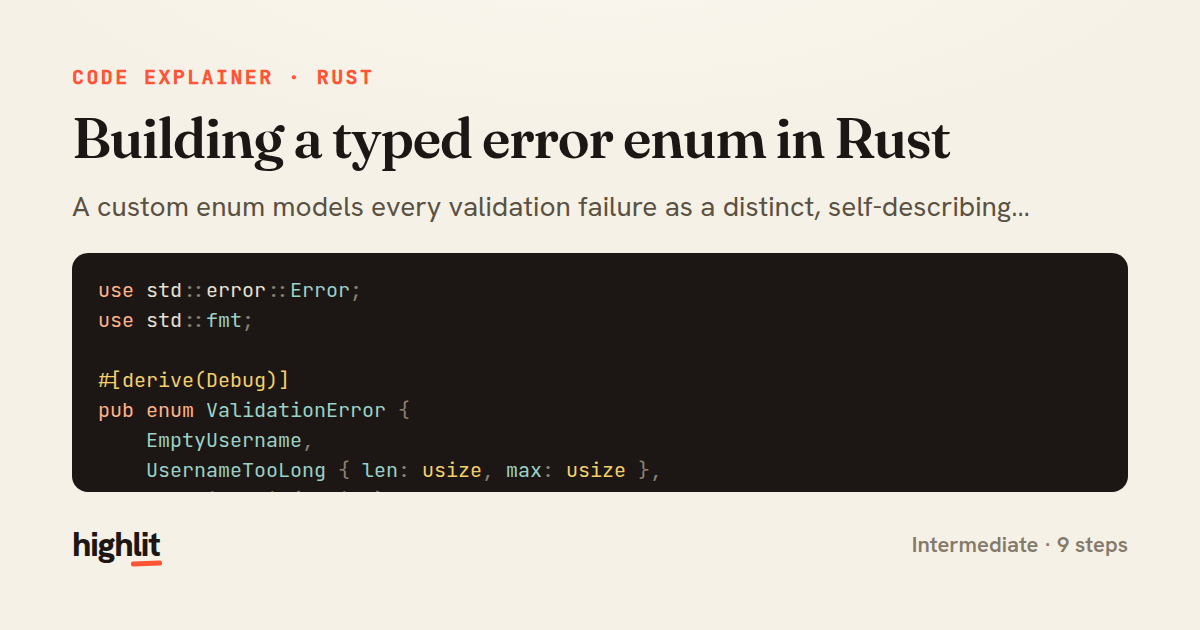
Made with highlit — turn any snippet into a walkthrough like this in about a minute.
Explain your code
Embed this explainer
Drop the interactive walkthrough into a blog or docs. Views never cost a credit.
<iframe src="https://highlit.co/explainers/building-a-typed-error-enum-in-rust-explained-rust-fd38/embed?autoplay=1" width="100%" height="520" loading="lazy" style="border:0"></iframe>
Autoplay is on by default — add ?autoplay=0 to start paused.