php
56 lines · 9 steps
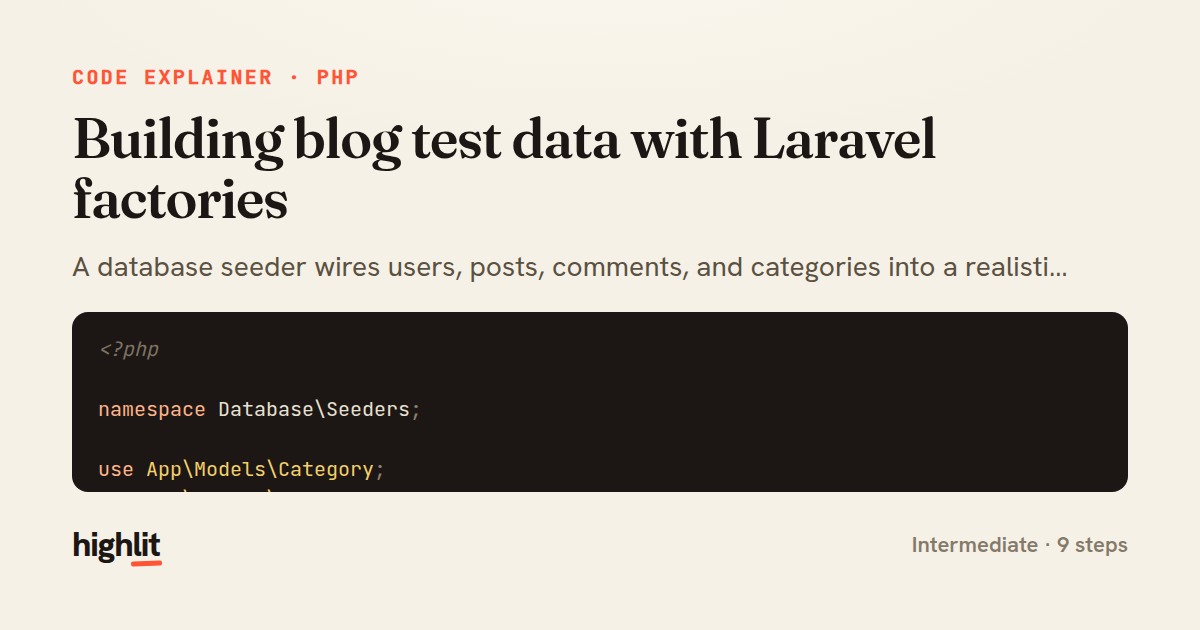
Building blog test data with Laravel factories
A database seeder wires users, posts, comments, and categories into a realistic graph using nested factory relationships.
Explained by
highlit
1<?php
2
3namespace Database\Seeders;
4
5use App\Models\Category;
6use App\Models\Comment;
7use App\Models\Post;
8use App\Models\User;
9use Illuminate\Database\Seeder;
10
11class BlogSeeder extends Seeder
12{
13 public function run(): void
14 {
15 $categories = Category::factory()
16 ->count(5)
17 ->create();
18
19 $authors = User::factory()
20 ->count(10)
21 ->has(
22 Post::factory()
23 ->count(8)
24 ->recycle($categories)
25 ->state(fn () => ['status' => 'published'])
26 ->has(Comment::factory()->count(3), 'comments')
27 ->afterCreating(function (Post $post) {
28 $post->categories()->attach(
29 Category::inRandomOrder()->take(2)->pluck('id')
30 );
31 }),
32 'posts'
33 )
34 ->create();
35
36 User::factory()
37 ->unverified()
38 ->count(3)
39 ->has(Post::factory()->count(2)->draft(), 'posts')
40 ->create();
41
42 Comment::factory()
43 ->count(40)
44 ->flagged()
45 ->recycle($authors)
46 ->for(Post::inRandomOrder()->first())
47 ->create();
48
49 User::factory()
50 ->admin()
51 ->create([
52 'name' => 'Editor In Chief',
53 'email' => 'editor@example.test',
54 ]);
55 }
56}
01 / 01
STEP 01
‹ swipe to step through ›
Walkthrough
Space play
←→ step
click any line
Three takeaways
- 1Nested factory calls with has() let you build an entire relationship tree in one create() statement.
- 2recycle() reuses existing models instead of spawning new ones, keeping foreign keys pointing at a shared pool.
- 3Factory states and callbacks like afterCreating() attach extra data such as pivot rows once records exist.
Related explainers
php
<?php

class NameParser
{
Parsing a full name into components in PHP
string-parsing
arrays
normalization
Intermediate
8 steps
php
<?php

namespace App\Services\Checkout;
Validating coupons with Laravel's Pipeline
pipeline
chain of responsibility
transactions
Intermediate
7 steps
php
<?php

namespace App\Services;
How a password strength validator works in PHP
validation
regular-expressions
data-driven
Intermediate
8 steps
php
<?php

namespace App\Services;
Building a cached daily leaderboard in Laravel
caching
aggregation
eager-loading
Intermediate
9 steps
php
<?php

final class RotatingFileLogger
{
How a rotating file logger works in PHP
logging
file-rotation
io
Intermediate
9 steps
php
class TwoFactorController extends Controller
{
    public function show(Request $request): View|RedirectResponse
    {
Two-factor auth challenge flow in Laravel
authentication
two-factor
middleware
Intermediate
10 steps
Share this explainer
Here's the card — post it anywhere.
Made with highlit — turn any snippet into a walkthrough like this in about a minute.
Explain your code
Embed this explainer
Drop the interactive walkthrough into a blog or docs. Views never cost a credit.
<iframe src="https://highlit.co/explainers/building-blog-test-data-with-laravel-factories-explained-php-ebf6/embed?autoplay=1" width="100%" height="520" loading="lazy" style="border:0"></iframe>
Autoplay is on by default — add ?autoplay=0 to start paused.