python
42 lines · 7 steps
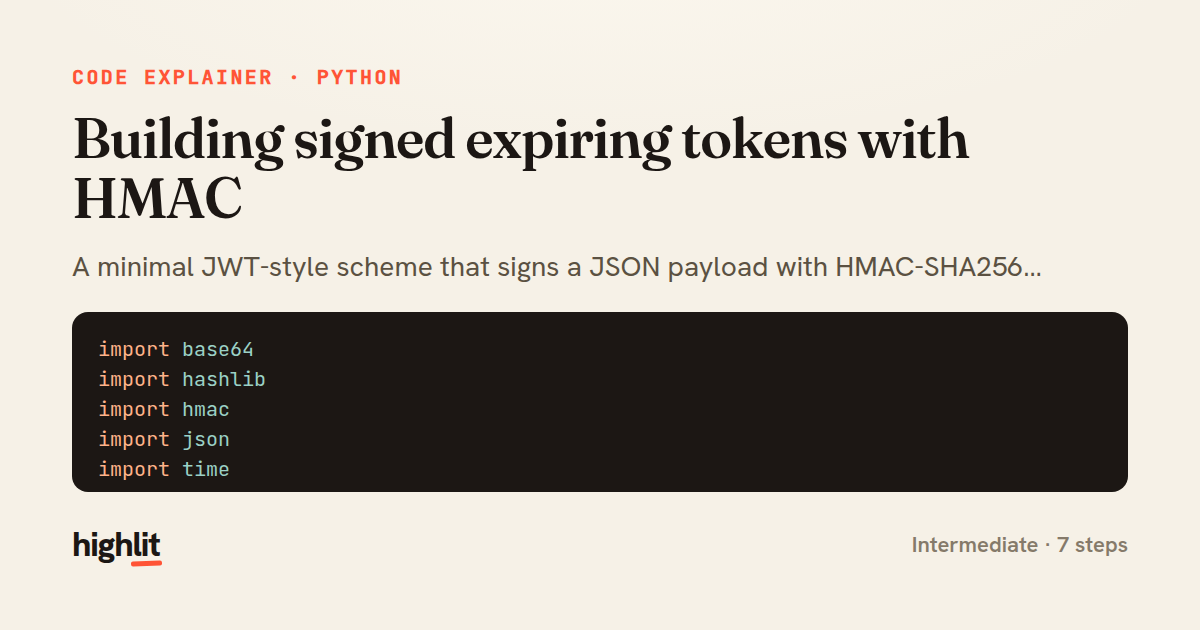
Building signed expiring tokens with HMAC
A minimal JWT-style scheme that signs a JSON payload with HMAC-SHA256 and verifies it in constant time.
Explained by
highlit
1import base64
2import hashlib
3import hmac
4import json
5import time
6
7
8class TokenError(Exception):
9 pass
10
11
12def _b64encode(raw: bytes) -> str:
13 return base64.urlsafe_b64encode(raw).rstrip(b"=").decode()
14
15
16def _b64decode(data: str) -> bytes:
17 padding = "=" * (-len(data) % 4)
18 return base64.urlsafe_b64decode(data + padding)
19
20
21def issue_token(payload: dict, secret: str, ttl: int = 3600) -> str:
22 body = dict(payload, exp=int(time.time()) + ttl)
23 encoded = _b64encode(json.dumps(body, separators=(",", ":")).encode())
24 signature = hmac.new(secret.encode(), encoded.encode(), hashlib.sha256).digest()
25 return f"{encoded}.{_b64encode(signature)}"
26
27
28def verify_token(token: str, secret: str) -> dict:
29 try:
30 encoded, provided = token.split(".", 1)
31 except ValueError:
32 raise TokenError("malformed token")
33
34 expected = hmac.new(secret.encode(), encoded.encode(), hashlib.sha256).digest()
35 if not hmac.compare_digest(expected, _b64decode(provided)):
36 raise TokenError("invalid signature")
37
38 payload = json.loads(_b64decode(encoded))
39 if payload.get("exp", 0) < int(time.time()):
40 raise TokenError("token expired")
41
42 return payload
01 / 01
STEP 01
‹ swipe to step through ›
Walkthrough
Space play
←→ step
click any line
Three takeaways
- 1Signing a payload with a shared secret lets you trust its contents without storing server-side state.
- 2Always compare signatures with a constant-time function to avoid leaking bytes through timing.
- 3Baking an expiry into the signed body means a stolen token stops working on its own.
Related explainers
python
from fastapi import FastAPI, WebSocket, WebSocketDisconnect

app = FastAPI()
Building a WebSocket chat with FastAPI
websockets
broadcast
connection-management
Intermediate
9 steps
java
@Component
@Converter
public class EncryptedStringConverter implements AttributeConverter<String, String> {
Transparent column encryption in Spring & JPA
encryption
aes-gcm
jpa-converter
Advanced
10 steps
python
import time
import uuid

from django.utils.deprecation import MiddlewareMixin
Attaching per-request context in Django
middleware
request lifecycle
multi-tenancy
Intermediate
7 steps
python
import random
from typing import Iterator, List
How reservoir sampling picks k items
reservoir-sampling
streaming
randomness
Intermediate
5 steps
python
import secrets

from django.contrib.auth import authenticate, login
from django.core.cache import cache
Two-factor login with OTP in Django
two-factor-auth
one-time-passwords
caching
Intermediate
9 steps
python
import re
from functools import total_ordering
from typing import Optional
Parsing and comparing semantic versions
regex
operator-overloading
sorting
Intermediate
7 steps
Share this explainer
Here's the card — post it anywhere.
Made with highlit — turn any snippet into a walkthrough like this in about a minute.
Explain your code
Embed this explainer
Drop the interactive walkthrough into a blog or docs. Views never cost a credit.
<iframe src="https://highlit.co/explainers/building-signed-expiring-tokens-with-hmac-explained-python-eb97/embed?autoplay=1" width="100%" height="520" loading="lazy" style="border:0"></iframe>
Autoplay is on by default — add ?autoplay=0 to start paused.