python
53 lines · 8 steps
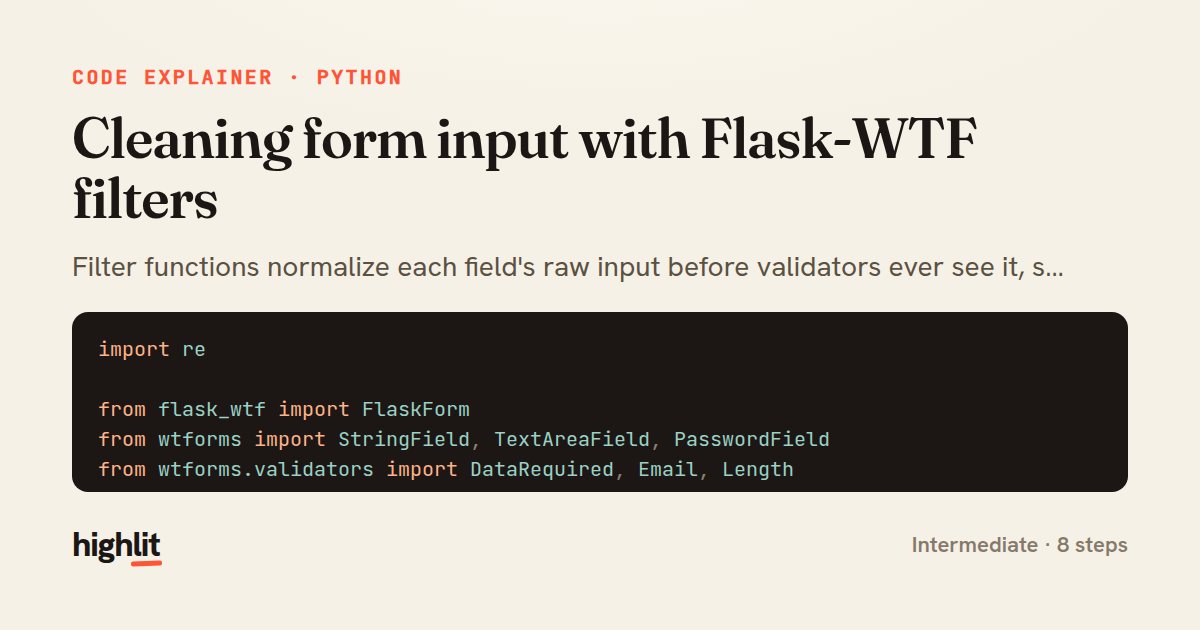
Cleaning form input with Flask-WTF filters
Filter functions normalize each field's raw input before validators ever see it, so validation runs against clean data.
Explained by
highlit
1import re
2
3from flask_wtf import FlaskForm
4from wtforms import StringField, TextAreaField, PasswordField
5from wtforms.validators import DataRequired, Email, Length
6
7_WHITESPACE_RUN = re.compile(r"\s+")
8
9
10def strip_whitespace(value):
11 if value is None:
12 return value
13 return value.strip()
14
15
16def collapse_whitespace(value):
17 if value is None:
18 return value
19 return _WHITESPACE_RUN.sub(" ", value).strip()
20
21
22def empty_to_none(value):
23 if value is None:
24 return value
25 stripped = value.strip()
26 return stripped or None
27
28
29class ProfileForm(FlaskForm):
30 full_name = StringField(
31 "Full name",
32 filters=[collapse_whitespace],
33 validators=[DataRequired(), Length(max=120)],
34 )
35 email = StringField(
36 "Email",
37 filters=[strip_whitespace, lambda v: v.lower() if v else v],
38 validators=[DataRequired(), Email()],
39 )
40 company = StringField(
41 "Company",
42 filters=[empty_to_none],
43 validators=[Length(max=120)],
44 )
45 bio = TextAreaField(
46 "Bio",
47 filters=[strip_whitespace],
48 validators=[Length(max=2000)],
49 )
50 password = PasswordField(
51 "Password",
52 validators=[DataRequired(), Length(min=8)],
53 )
01 / 01
STEP 01
‹ swipe to step through ›
Walkthrough
Space play
←→ step
click any line
Three takeaways
- 1Filters transform submitted values before validators run, so validation checks the cleaned data.
- 2Guarding each filter against None keeps normalization safe for fields that were never filled in.
- 3Small composable filter functions let you mix and match normalization per field without duplicating logic.
Related explainers
python
from fastapi import FastAPI, WebSocket, WebSocketDisconnect

app = FastAPI()
Building a WebSocket chat with FastAPI
websockets
broadcast
connection-management
Intermediate
9 steps
ruby
class UserAgentParser
  BROWSERS = [
    [/Edg\/([\d.]+)/, "Edge"],
    [/OPR\/([\d.]+)/, "Opera"],
Parsing user-agent strings in Ruby
regex
pattern-matching
lookup-tables
Intermediate
8 steps
python
import time
import uuid

from django.utils.deprecation import MiddlewareMixin
Attaching per-request context in Django
middleware
request lifecycle
multi-tenancy
Intermediate
7 steps
python
import random
from typing import Iterator, List
How reservoir sampling picks k items
reservoir-sampling
streaming
randomness
Intermediate
5 steps
python
import secrets

from django.contrib.auth import authenticate, login
from django.core.cache import cache
Two-factor login with OTP in Django
two-factor-auth
one-time-passwords
caching
Intermediate
9 steps
python
import re
from functools import total_ordering
from typing import Optional
Parsing and comparing semantic versions
regex
operator-overloading
sorting
Intermediate
7 steps
Share this explainer
Here's the card — post it anywhere.
Made with highlit — turn any snippet into a walkthrough like this in about a minute.
Explain your code
Embed this explainer
Drop the interactive walkthrough into a blog or docs. Views never cost a credit.
<iframe src="https://highlit.co/explainers/cleaning-form-input-with-flask-wtf-filters-explained-python-f3f1/embed?autoplay=1" width="100%" height="520" loading="lazy" style="border:0"></iframe>
Autoplay is on by default — add ?autoplay=0 to start paused.