javascript
48 lines · 8 steps
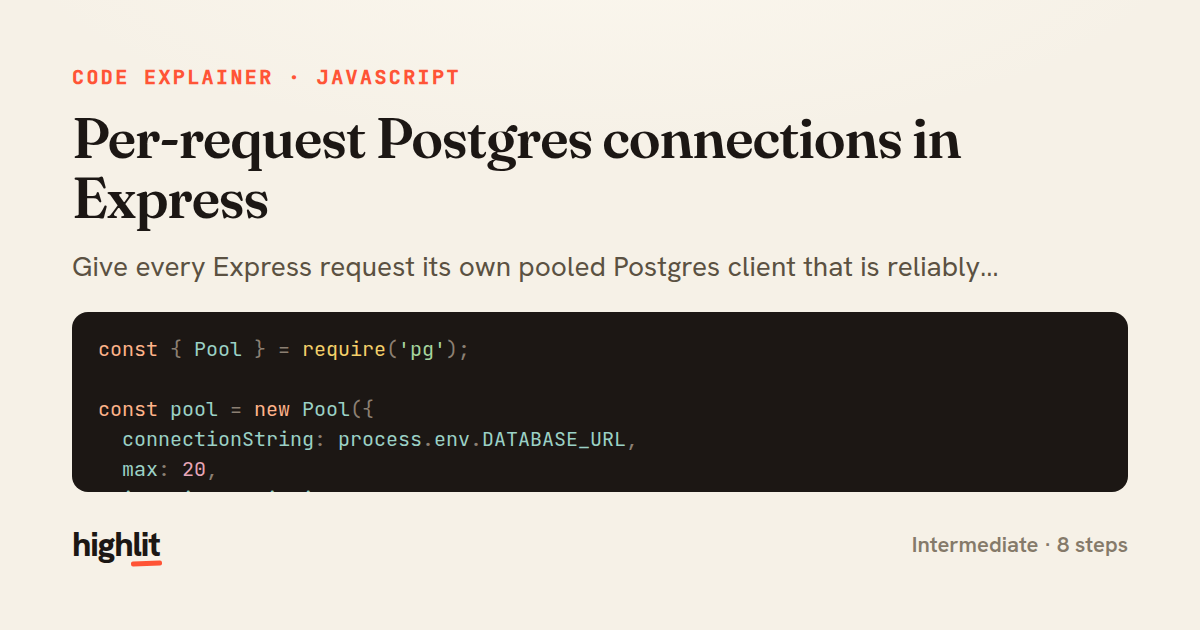
Per-request Postgres connections in Express
Give every Express request its own pooled Postgres client that is reliably released when the response ends.
Explained by
highlit
1const { Pool } = require('pg');
2
3const pool = new Pool({
4 connectionString: process.env.DATABASE_URL,
5 max: 20,
6 idleTimeoutMillis: 30000,
7 connectionTimeoutMillis: 5000,
8});
9
10function attachDb(app) {
11 app.locals.pool = pool;
12
13 app.use(async (req, res, next) => {
14 const client = await pool.connect();
15 req.db = client;
16
17 let released = false;
18 const release = () => {
19 if (released) return;
20 released = true;
21 client.release();
22 };
23
24 res.on('finish', release);
25 res.on('close', release);
26
27 next();
28 });
29}
30
31async function withTransaction(req, work) {
32 const { db } = req;
33 await db.query('BEGIN');
34 try {
35 const result = await work(db);
36 await db.query('COMMIT');
37 return result;
38 } catch (err) {
39 await db.query('ROLLBACK');
40 throw err;
41 }
42}
43
44async function shutdown() {
45 await pool.end();
46}
47
48module.exports = { attachDb, withTransaction, shutdown };
01 / 01
STEP 01
‹ swipe to step through ›
Walkthrough
Space play
←→ step
click any line
Three takeaways
- 1A connection pool caps concurrent database clients and hands them out on demand instead of opening a socket per query.
- 2Tying client release to response lifecycle events prevents leaks even when a handler forgets to clean up.
- 3Wrapping work in BEGIN/COMMIT with a ROLLBACK on error keeps multi-step database changes atomic.
Related explainers
php
<?php

namespace App\Services\Checkout;
Validating coupons with Laravel's Pipeline
pipeline
chain of responsibility
transactions
Intermediate
7 steps
python
import time
import uuid

from django.utils.deprecation import MiddlewareMixin
Attaching per-request context in Django
middleware
request lifecycle
multi-tenancy
Intermediate
7 steps
javascript
function evaluate(expression) {
  const tokens = tokenize(expression);
  let pos = 0;
Building a recursive descent calculator
parsing
recursion
operator-precedence
Intermediate
8 steps
javascript
import { useState, useEffect, useCallback, useRef } from 'react';

const cache = new Map();
const inflight = new Map();
Building a stale-while-revalidate hook in React
caching
request-deduplication
custom-hooks
Advanced
10 steps
typescript
import { Injectable, Scope, Inject, NotFoundException } from '@nestjs/common';
import { REQUEST } from '@nestjs/core';
import { Request } from 'express';
import { DataSource } from 'typeorm';
Per-tenant database connections in NestJS
multi-tenancy
connection-pooling
dependency-injection
Advanced
8 steps
javascript
import { useEffect, useRef, useState } from 'react';

export function useDelayedFlag(active, delay = 300) {
  const [visible, setVisible] = useState(false);
Delaying a loading spinner with a React hook
custom-hooks
debouncing
cleanup
Intermediate
8 steps
Share this explainer
Here's the card — post it anywhere.
Made with highlit — turn any snippet into a walkthrough like this in about a minute.
Explain your code
Embed this explainer
Drop the interactive walkthrough into a blog or docs. Views never cost a credit.
<iframe src="https://highlit.co/explainers/per-request-postgres-connections-in-express-explained-javascript-3b7b/embed?autoplay=1" width="100%" height="520" loading="lazy" style="border:0"></iframe>
Autoplay is on by default — add ?autoplay=0 to start paused.