python
42 lines · 7 steps
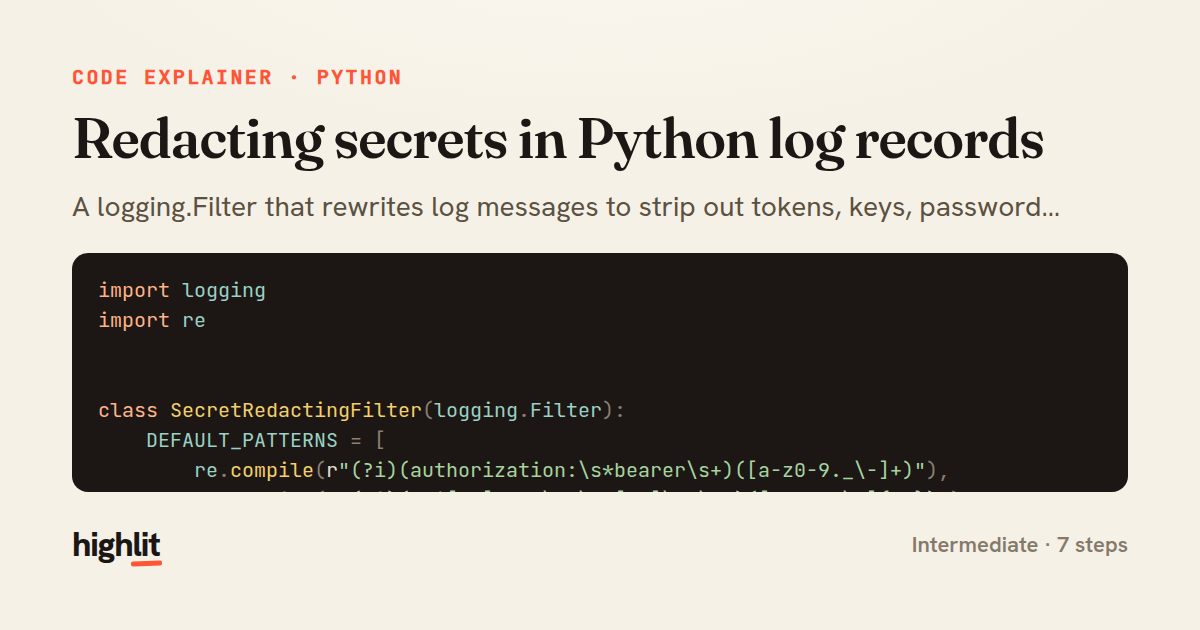
Redacting secrets in Python log records
A logging.Filter that rewrites log messages to strip out tokens, keys, passwords, and card numbers before they hit disk.
Explained by
highlit
1import logging
2import re
3
4
5class SecretRedactingFilter(logging.Filter):
6 DEFAULT_PATTERNS = [
7 re.compile(r"(?i)(authorization:\s*bearer\s+)([a-z0-9._\-]+)"),
8 re.compile(r"(?i)(api[_-]?key\"?\s*[:=]\s*\"?)([a-z0-9\-]{8,})"),
9 re.compile(r"(?i)(password\"?\s*[:=]\s*\"?)([^\s\"&]+)"),
10 re.compile(r"\b([A-Za-z0-9+/]{40,})={0,2}\b"),
11 re.compile(r"\b(\d[ -]?){13,16}\b"),
12 ]
13
14 def __init__(self, patterns=None, placeholder="[REDACTED]"):
15 super().__init__()
16 self.patterns = patterns or self.DEFAULT_PATTERNS
17 self.placeholder = placeholder
18
19 def _scrub(self, value):
20 if not isinstance(value, str):
21 return value
22 for pattern in self.patterns:
23 if pattern.groups >= 2:
24 value = pattern.sub(lambda m: m.group(1) + self.placeholder, value)
25 else:
26 value = pattern.sub(self.placeholder, value)
27 return value
28
29 def filter(self, record):
30 record.msg = self._scrub(record.getMessage())
31 record.args = ()
32 if isinstance(record.args, tuple):
33 record.args = tuple(self._scrub(a) for a in record.args)
34 return True
35
36
37def install_redaction(logger=None):
38 target = logger or logging.getLogger()
39 redactor = SecretRedactingFilter()
40 for handler in target.handlers:
41 handler.addFilter(redactor)
42 return redactor
01 / 01
STEP 01
‹ swipe to step through ›
Walkthrough
Space play
←→ step
click any line
Three takeaways
- 1Subclassing logging.Filter lets you mutate records in-flight before any handler formats them.
- 2Regex capture groups let you keep the label but replace only the secret that follows it.
- 3Attaching a filter to handlers scrubs output no matter where the log call originated.
Related explainers
python
from fastapi import FastAPI, WebSocket, WebSocketDisconnect

app = FastAPI()
Building a WebSocket chat with FastAPI
websockets
broadcast
connection-management
Intermediate
9 steps
ruby
class UserAgentParser
  BROWSERS = [
    [/Edg\/([\d.]+)/, "Edge"],
    [/OPR\/([\d.]+)/, "Opera"],
Parsing user-agent strings in Ruby
regex
pattern-matching
lookup-tables
Intermediate
8 steps
python
import time
import uuid

from django.utils.deprecation import MiddlewareMixin
Attaching per-request context in Django
middleware
request lifecycle
multi-tenancy
Intermediate
7 steps
python
import random
from typing import Iterator, List
How reservoir sampling picks k items
reservoir-sampling
streaming
randomness
Intermediate
5 steps
python
import secrets

from django.contrib.auth import authenticate, login
from django.core.cache import cache
Two-factor login with OTP in Django
two-factor-auth
one-time-passwords
caching
Intermediate
9 steps
php
<?php

final class RotatingFileLogger
{
How a rotating file logger works in PHP
logging
file-rotation
io
Intermediate
9 steps
Share this explainer
Here's the card — post it anywhere.
Made with highlit — turn any snippet into a walkthrough like this in about a minute.
Explain your code
Embed this explainer
Drop the interactive walkthrough into a blog or docs. Views never cost a credit.
<iframe src="https://highlit.co/explainers/redacting-secrets-in-python-log-records-explained-python-7a33/embed?autoplay=1" width="100%" height="520" loading="lazy" style="border:0"></iframe>
Autoplay is on by default — add ?autoplay=0 to start paused.