php
45 lines · 8 steps
Resolving the current team in Laravel middleware
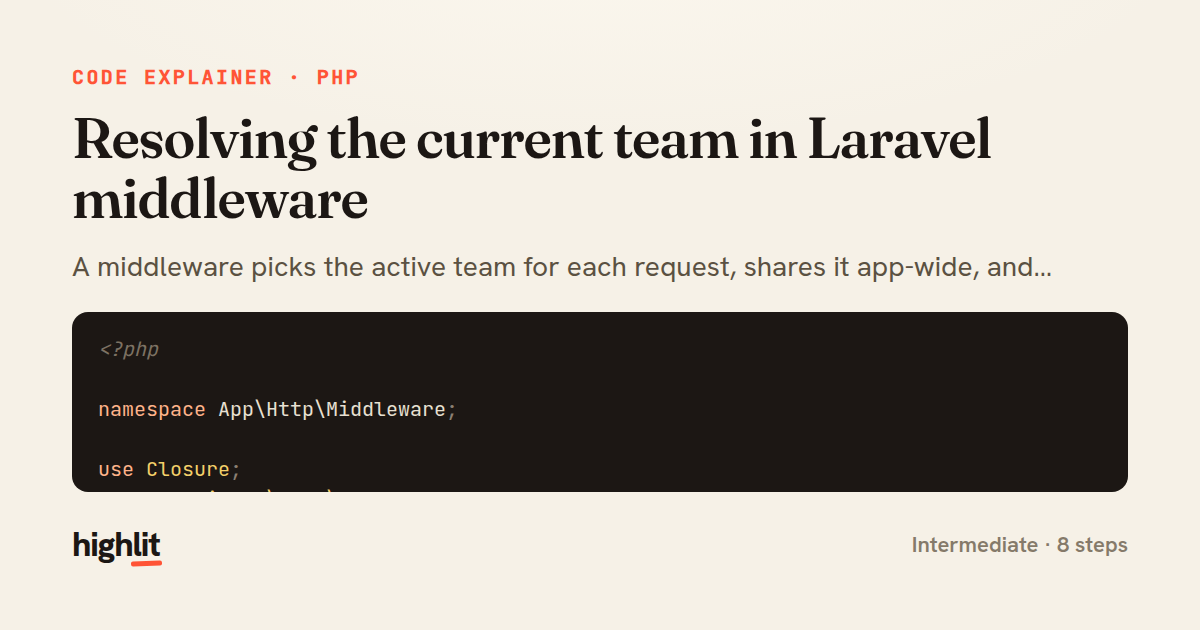
A middleware picks the active team for each request, shares it app-wide, and remembers the choice in a cookie.
Explained by
highlit
1<?php
2
3namespace App\Http\Middleware;
4
5use Closure;
6use Illuminate\Http\Request;
7use Illuminate\Support\Facades\Cookie;
8use Symfony\Component\HttpFoundation\Response;
9
10class ResolveCurrentTeam
11{
12 protected const COOKIE = 'current_team';
13 protected const TTL = 60 * 24 * 365;
14
15 public function handle(Request $request, Closure $next): Response
16 {
17 $user = $request->user();
18
19 if (! $user) {
20 return $next($request);
21 }
22
23 $teamId = $request->route('team')
24 ?? $request->cookie(self::COOKIE);
25
26 $team = $user->teams()->find($teamId)
27 ?? $user->currentTeam
28 ?? $user->teams()->first();
29
30 abort_if($team === null, 403, 'You do not belong to any team.');
31
32 app()->instance('current_team', $team);
33 $request->attributes->set('current_team', $team);
34
35 $response = $next($request);
36
37 if ((string) $request->cookie(self::COOKIE) !== (string) $team->getKey()) {
38 $response->withCookie(
39 Cookie::make(self::COOKIE, $team->getKey(), self::TTL)
40 );
41 }
42
43 return $response;
44 }
45}
01 / 01
STEP 01
‹ swipe to step through ›
Walkthrough
Space play
←→ step
click any line
Three takeaways
- 1Chained null-coalescing operators express a clean priority order of fallbacks for resolving a value.
- 2Binding a resolved object into the container and request attributes lets the rest of the app read it without re-querying.
- 3Writing the cookie only when the value actually changed avoids emitting a redundant Set-Cookie on every response.
Related explainers
php
<?php

class NameParser
{
Parsing a full name into components in PHP
string-parsing
arrays
normalization
Intermediate
8 steps
php
<?php

namespace App\Services\Checkout;
Validating coupons with Laravel's Pipeline
pipeline
chain of responsibility
transactions
Intermediate
7 steps
python
import time
import uuid

from django.utils.deprecation import MiddlewareMixin
Attaching per-request context in Django
middleware
request lifecycle
multi-tenancy
Intermediate
7 steps
php
<?php

namespace App\Services;
How a password strength validator works in PHP
validation
regular-expressions
data-driven
Intermediate
8 steps
php
<?php

namespace App\Services;
Building a cached daily leaderboard in Laravel
caching
aggregation
eager-loading
Intermediate
9 steps
ruby
class ApplicationController < ActionController::Base
  EXPERIMENTS = {
    checkout_button_color: %w[control blue green],
    onboarding_flow: %w[control streamlined]
How A/B test cohorts are assigned in Rails
a-b-testing
cookies
hashing
Intermediate
8 steps
Share this explainer
Here's the card — post it anywhere.
Made with highlit — turn any snippet into a walkthrough like this in about a minute.
Explain your code
Embed this explainer
Drop the interactive walkthrough into a blog or docs. Views never cost a credit.
<iframe src="https://highlit.co/explainers/resolving-the-current-team-in-laravel-middleware-explained-php-42b1/embed?autoplay=1" width="100%" height="520" loading="lazy" style="border:0"></iframe>
Autoplay is on by default — add ?autoplay=0 to start paused.