python
21 lines · 6 steps
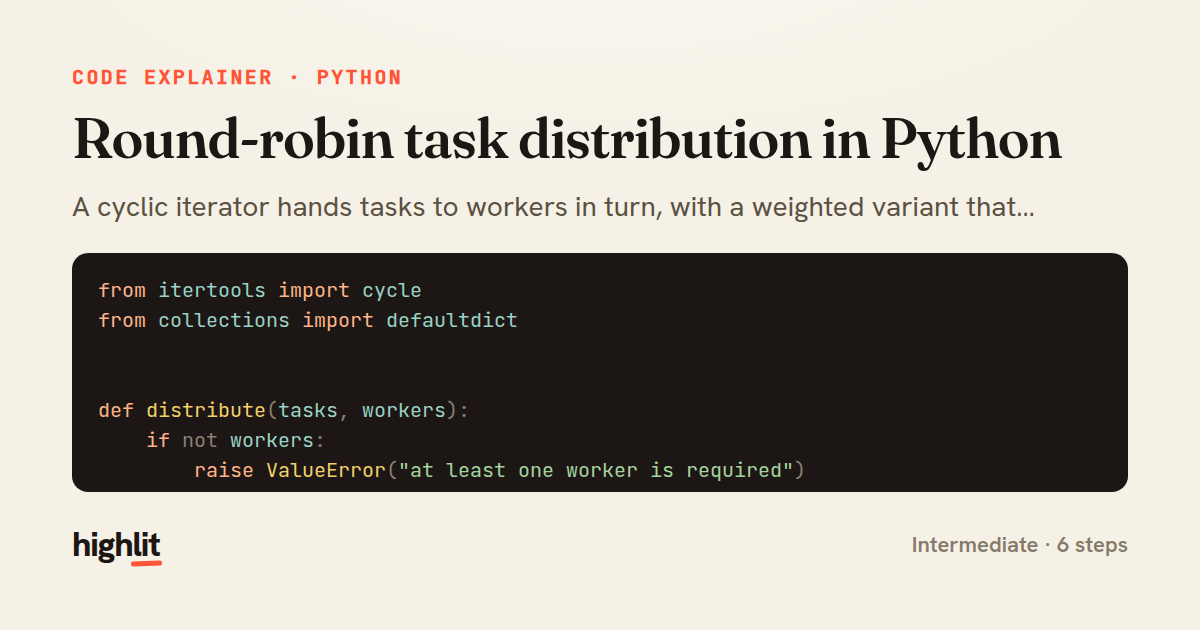
Round-robin task distribution in Python
A cyclic iterator hands tasks to workers in turn, with a weighted variant that skews the rotation by capacity.
Explained by
highlit
1from itertools import cycle
2from collections import defaultdict
3
4
5def distribute(tasks, workers):
6 if not workers:
7 raise ValueError("at least one worker is required")
8
9 assignments = defaultdict(list)
10 worker_pool = cycle(workers)
11
12 for task in tasks:
13 worker = next(worker_pool)
14 assignments[worker].append(task)
15
16 return dict(assignments)
17
18
19def distribute_weighted(tasks, workers):
20 expanded = [w for w in workers for _ in range(w.capacity)]
21 return distribute(tasks, expanded)
01 / 01
STEP 01
‹ swipe to step through ›
Walkthrough
Space play
←→ step
click any line
Three takeaways
- 1itertools.cycle turns any finite sequence into an endless round-robin without tracking an index yourself.
- 2defaultdict(list) removes the need to check for and initialize missing keys before appending.
- 3Weighting a round-robin can be as simple as repeating each item in the pool proportionally to its weight.
Related explainers
python
from fastapi import FastAPI, WebSocket, WebSocketDisconnect

app = FastAPI()
Building a WebSocket chat with FastAPI
websockets
broadcast
connection-management
Intermediate
9 steps
python
import time
import uuid

from django.utils.deprecation import MiddlewareMixin
Attaching per-request context in Django
middleware
request lifecycle
multi-tenancy
Intermediate
7 steps
rust
use std::f64::consts::PI;

#[derive(Debug, Clone, Copy)]
pub struct LatLng {
Building geographic bounding boxes in Rust
geospatial
value-types
option
Intermediate
7 steps
python
import random
from typing import Iterator, List
How reservoir sampling picks k items
reservoir-sampling
streaming
randomness
Intermediate
5 steps
rust
use chrono::{Duration, NaiveDate};

#[derive(Debug)]
pub struct DateRange {
Parsing and iterating date ranges in Rust
error-handling
iterators
parsing
Intermediate
7 steps
python
import secrets

from django.contrib.auth import authenticate, login
from django.core.cache import cache
Two-factor login with OTP in Django
two-factor-auth
one-time-passwords
caching
Intermediate
9 steps
Share this explainer
Here's the card — post it anywhere.
Made with highlit — turn any snippet into a walkthrough like this in about a minute.
Explain your code
Embed this explainer
Drop the interactive walkthrough into a blog or docs. Views never cost a credit.
<iframe src="https://highlit.co/explainers/round-robin-task-distribution-in-python-explained-python-98c0/embed?autoplay=1" width="100%" height="520" loading="lazy" style="border:0"></iframe>
Autoplay is on by default — add ?autoplay=0 to start paused.