go
40 lines · 6 steps
Streaming a JSON array in Go
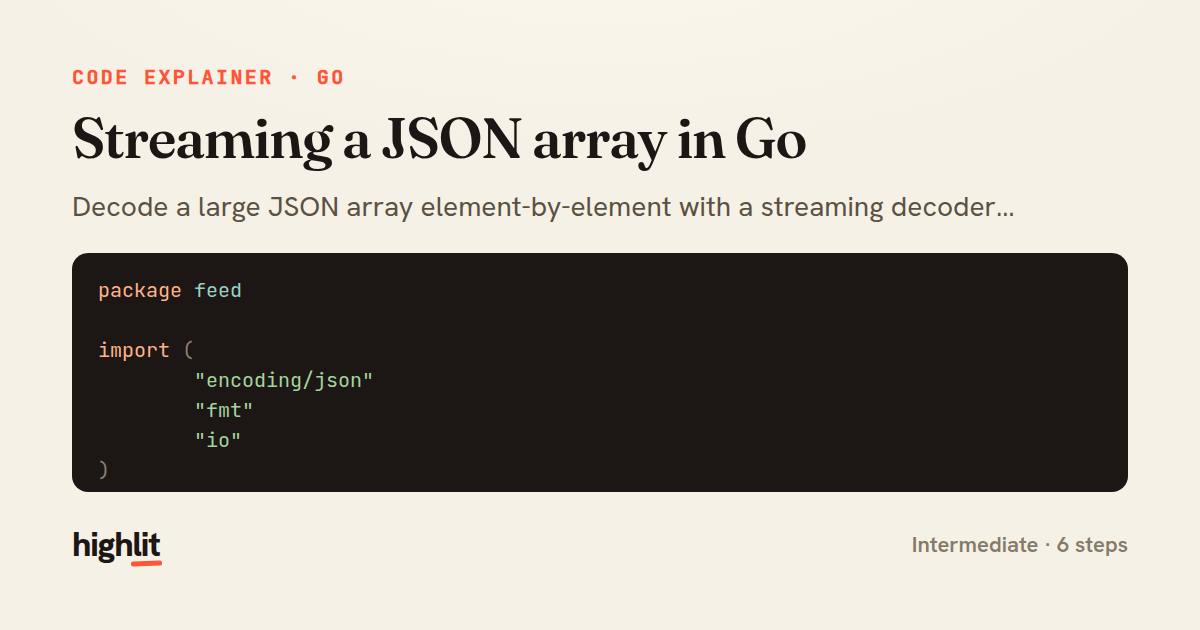
Decode a large JSON array element-by-element with a streaming decoder instead of loading it all into memory.
Explained by
highlit
1package feed
2
3import (
4 "encoding/json"
5 "fmt"
6 "io"
7)
8
9type Event struct {
10 ID string `json:"id"`
11 Type string `json:"type"`
12 Payload json.RawMessage `json:"payload"`
13}
14
15func StreamEvents(r io.Reader, handle func(Event) error) error {
16 dec := json.NewDecoder(r)
17
18 tok, err := dec.Token()
19 if err != nil {
20 return fmt.Errorf("read opening token: %w", err)
21 }
22 if delim, ok := tok.(json.Delim); !ok || delim != '[' {
23 return fmt.Errorf("expected JSON array, got %v", tok)
24 }
25
26 for dec.More() {
27 var ev Event
28 if err := dec.Decode(&ev); err != nil {
29 return fmt.Errorf("decode event: %w", err)
30 }
31 if err := handle(ev); err != nil {
32 return fmt.Errorf("handle event %s: %w", ev.ID, err)
33 }
34 }
35
36 if _, err := dec.Token(); err != nil {
37 return fmt.Errorf("read closing token: %w", err)
38 }
39 return nil
40}
01 / 01
STEP 01
‹ swipe to step through ›
Walkthrough
Space play
←→ step
click any line
Three takeaways
- 1json.Decoder can walk a document token-by-token, letting you process arbitrarily large arrays without buffering the whole thing.
- 2json.RawMessage defers parsing of a field so each consumer can interpret the payload on its own terms.
- 3Wrapping errors with %w preserves the underlying cause while adding context at each layer.
Related explainers
rust
use serde::Deserialize;

#[derive(Debug, Deserialize)]
#[serde(untagged)]
Parsing flexible JSON shapes with serde
deserialization
enums
json
Intermediate
6 steps
go
package streaming

import (
	"bufio"
Streaming NDJSON logs over HTTP in Go
http-streaming
channels
select
Advanced
10 steps
go
package api

import (
	"crypto/sha256"
ETag conditional requests in Gin
http-caching
etag
conditional-requests
Intermediate
6 steps
go
func (w *Watcher) resetDebounce(d time.Duration) {
	if !w.timer.Stop() {
		select {
		case <-w.timer.C:
Debouncing a stream of events in Go
debounce
timers
channels
Advanced
7 steps
python
import random
from typing import Iterator, List
How reservoir sampling picks k items
reservoir-sampling
streaming
randomness
Intermediate
5 steps
go
package logging

import (
	"context"
Deduplicating log attributes in Go's slog
decorator-pattern
structured-logging
immutability
Intermediate
8 steps
Share this explainer
Here's the card — post it anywhere.
Made with highlit — turn any snippet into a walkthrough like this in about a minute.
Explain your code
Embed this explainer
Drop the interactive walkthrough into a blog or docs. Views never cost a credit.
<iframe src="https://highlit.co/explainers/streaming-a-json-array-in-go-explained-go-e402/embed?autoplay=1" width="100%" height="520" loading="lazy" style="border:0"></iframe>
Autoplay is on by default — add ?autoplay=0 to start paused.