python
41 lines · 7 steps
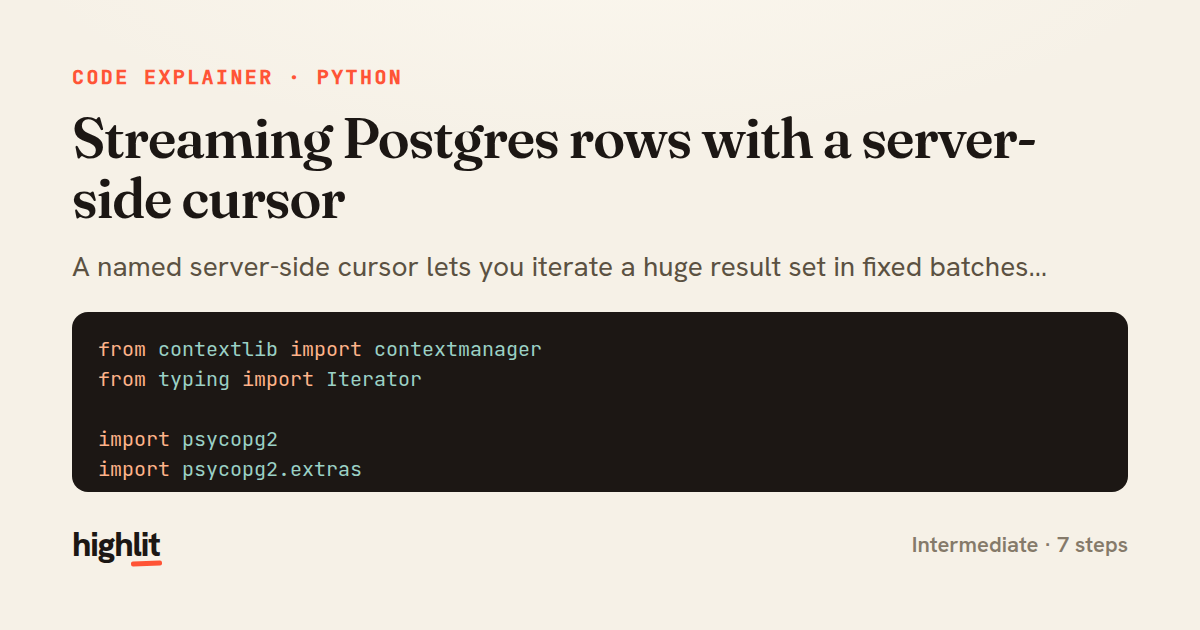
Streaming Postgres rows with a server-side cursor
A named server-side cursor lets you iterate a huge result set in fixed batches without loading it all into memory.
Explained by
highlit
1from contextlib import contextmanager
2from typing import Iterator
3
4import psycopg2
5import psycopg2.extras
6
7
8@contextmanager
9def server_side_cursor(dsn: str, name: str, itersize: int = 2000):
10 conn = psycopg2.connect(dsn)
11 try:
12 cursor = conn.cursor(name=name, cursor_factory=psycopg2.extras.RealDictCursor)
13 cursor.itersize = itersize
14 try:
15 yield cursor
16 finally:
17 cursor.close()
18 finally:
19 conn.close()
20
21
22def stream_orders(dsn: str, since: str, batch_size: int = 2000) -> Iterator[dict]:
23 query = """
24 SELECT id, customer_id, total_cents, placed_at
25 FROM orders
26 WHERE placed_at >= %s
27 ORDER BY placed_at
28 """
29 with server_side_cursor(dsn, "orders_stream", batch_size) as cursor:
30 cursor.execute(query, (since,))
31 for row in cursor:
32 yield row
33
34
35def export_revenue_by_customer(dsn: str, since: str) -> dict[int, int]:
36 totals: dict[int, int] = {}
37 for order in stream_orders(dsn, since):
38 totals[order["customer_id"]] = (
39 totals.get(order["customer_id"], 0) + order["total_cents"]
40 )
41 return totals
01 / 01
STEP 01
‹ swipe to step through ›
Walkthrough
Space play
←→ step
click any line
Three takeaways
- 1Named cursors keep the result set on the server so the client fetches rows in bounded batches.
- 2Nested try/finally blocks guarantee both cursor and connection close even when iteration fails midway.
- 3Chaining generators lets you aggregate an arbitrarily large dataset with constant memory.
Related explainers
python
from fastapi import FastAPI, WebSocket, WebSocketDisconnect

app = FastAPI()
Building a WebSocket chat with FastAPI
websockets
broadcast
connection-management
Intermediate
9 steps
python
import time
import uuid

from django.utils.deprecation import MiddlewareMixin
Attaching per-request context in Django
middleware
request lifecycle
multi-tenancy
Intermediate
7 steps
python
import random
from typing import Iterator, List
How reservoir sampling picks k items
reservoir-sampling
streaming
randomness
Intermediate
5 steps
python
import secrets

from django.contrib.auth import authenticate, login
from django.core.cache import cache
Two-factor login with OTP in Django
two-factor-auth
one-time-passwords
caching
Intermediate
9 steps
python
import re
from functools import total_ordering
from typing import Optional
Parsing and comparing semantic versions
regex
operator-overloading
sorting
Intermediate
7 steps
python
from typing import Any, Sequence, Mapping


def render_markdown_table(
Rendering an aligned Markdown table in Python
string formatting
data transformation
closures
Intermediate
8 steps
Share this explainer
Here's the card — post it anywhere.
Made with highlit — turn any snippet into a walkthrough like this in about a minute.
Explain your code
Embed this explainer
Drop the interactive walkthrough into a blog or docs. Views never cost a credit.
<iframe src="https://highlit.co/explainers/streaming-postgres-rows-with-a-server-side-cursor-explained-python-a862/embed?autoplay=1" width="100%" height="520" loading="lazy" style="border:0"></iframe>
Autoplay is on by default — add ?autoplay=0 to start paused.