php
51 lines · 6 steps
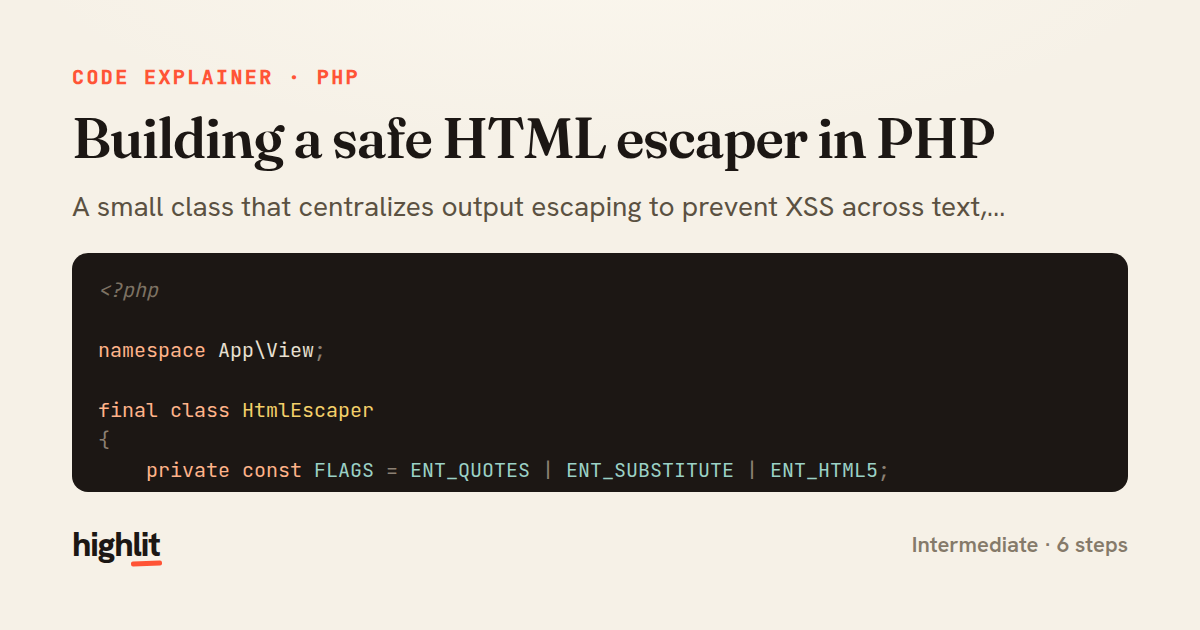
Building a safe HTML escaper in PHP
A small class that centralizes output escaping to prevent XSS across text, attributes, and URLs.
Explained by
highlit
1<?php
2
3namespace App\View;
4
5final class HtmlEscaper
6{
7 private const FLAGS = ENT_QUOTES | ENT_SUBSTITUTE | ENT_HTML5;
8
9 public function __construct(private readonly string $encoding = 'UTF-8')
10 {
11 }
12
13 public function escape(?string $value): string
14 {
15 if ($value === null || $value === '') {
16 return '';
17 }
18
19 return htmlspecialchars($value, self::FLAGS, $this->encoding);
20 }
21
22 public function escapeAttribute(?string $value): string
23 {
24 return $this->escape($value);
25 }
26
27 public function escapeUrl(?string $url): string
28 {
29 if ($url === null) {
30 return '';
31 }
32
33 $scheme = parse_url($url, PHP_URL_SCHEME);
34
35 if ($scheme !== null && !in_array(strtolower($scheme), ['http', 'https', 'mailto'], true)) {
36 return '#';
37 }
38
39 return $this->escape($url);
40 }
41
42 public function renderComment(string $author, string $body, string $profileUrl): string
43 {
44 return sprintf(
45 '<article class="comment"><a href="%s">%s</a><p>%s</p></article>',
46 $this->escapeUrl($profileUrl),
47 $this->escape($author),
48 nl2br($this->escape($body), false)
49 );
50 }
51}
01 / 01
STEP 01
‹ swipe to step through ›
Walkthrough
Space play
←→ step
click any line
Three takeaways
- 1Centralizing escaping in one class makes safe output the default and the unsafe path the exception.
- 2Different output contexts (text, attribute, URL) need different defenses, not one blanket escape.
- 3Validating a URL scheme blocks javascript: and data: payloads that plain HTML escaping would let through.
Related explainers
php
<?php

class NameParser
{
Parsing a full name into components in PHP
string-parsing
arrays
normalization
Intermediate
8 steps
php
<?php

namespace App\Services\Checkout;
Validating coupons with Laravel's Pipeline
pipeline
chain of responsibility
transactions
Intermediate
7 steps
php
<?php

namespace App\Services;
How a password strength validator works in PHP
validation
regular-expressions
data-driven
Intermediate
8 steps
php
<?php

namespace App\Services;
Building a cached daily leaderboard in Laravel
caching
aggregation
eager-loading
Intermediate
9 steps
php
<?php

final class RotatingFileLogger
{
How a rotating file logger works in PHP
logging
file-rotation
io
Intermediate
9 steps
go
package middleware

import (
	"net/http"
Per-plan export limits in Gin middleware
middleware
rate-limiting
authorization
Intermediate
7 steps
Share this explainer
Here's the card — post it anywhere.
Made with highlit — turn any snippet into a walkthrough like this in about a minute.
Explain your code
Embed this explainer
Drop the interactive walkthrough into a blog or docs. Views never cost a credit.
<iframe src="https://highlit.co/explainers/building-a-safe-html-escaper-in-php-explained-php-bdef/embed?autoplay=1" width="100%" height="520" loading="lazy" style="border:0"></iframe>
Autoplay is on by default — add ?autoplay=0 to start paused.