javascript
44 lines · 8 steps
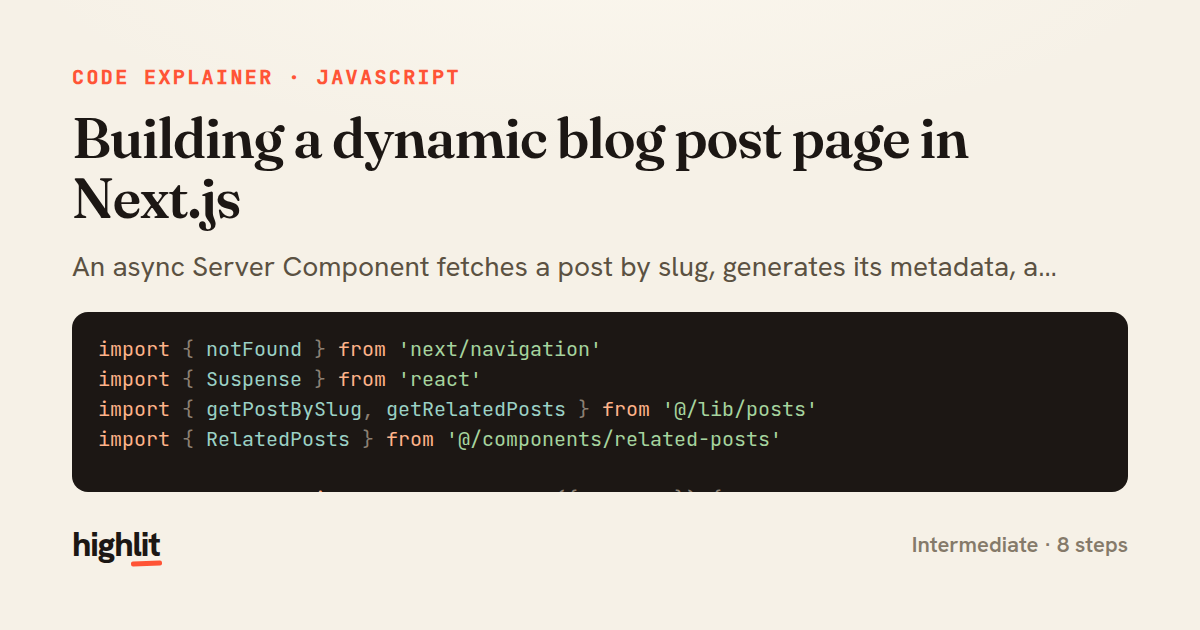
Building a dynamic blog post page in Next.js
An async Server Component fetches a post by slug, generates its metadata, and streams related posts with Suspense.
Explained by
highlit
1import { notFound } from 'next/navigation'
2import { Suspense } from 'react'
3import { getPostBySlug, getRelatedPosts } from '@/lib/posts'
4import { RelatedPosts } from '@/components/related-posts'
5
6export async function generateMetadata({ params }) {
7 const { slug } = await params
8 const post = await getPostBySlug(slug)
9
10 if (!post) {
11 return { title: 'Post not found' }
12 }
13
14 return {
15 title: post.title,
16 description: post.excerpt,
17 }
18}
19
20export default async function PostPage({ params }) {
21 const { slug } = await params
22 const post = await getPostBySlug(slug)
23
24 if (!post || post.status !== 'published') {
25 notFound()
26 }
27
28 return (
29 <article className="prose mx-auto py-12">
30 <header>
31 <h1>{post.title}</h1>
32 <time dateTime={post.publishedAt}>
33 {new Date(post.publishedAt).toLocaleDateString()}
34 </time>
35 </header>
36
37 <div dangerouslySetInnerHTML={{ __html: post.html }} />
38
39 <Suspense fallback={<p>Loading related posts…</p>}>
40 <RelatedPosts promise={getRelatedPosts(post.id)} />
41 </Suspense>
42 </article>
43 )
44}
01 / 01
STEP 01
‹ swipe to step through ›
Walkthrough
Space play
←→ step
click any line
Three takeaways
- 1Async Server Components let you await data directly in the component body instead of wiring up client-side fetching.
- 2generateMetadata and the page share the same data-loading pattern so SEO tags and rendered content stay in sync.
- 3Passing an unawaited promise into a Suspense boundary streams slower content without blocking the main article.
Related explainers
javascript
function evaluate(expression) {
  const tokens = tokenize(expression);
  let pos = 0;
Building a recursive descent calculator
parsing
recursion
operator-precedence
Intermediate
8 steps
javascript
import { useState, useEffect, useCallback, useRef } from 'react';

const cache = new Map();
const inflight = new Map();
Building a stale-while-revalidate hook in React
caching
request-deduplication
custom-hooks
Advanced
10 steps
python
import random
from typing import Iterator, List
How reservoir sampling picks k items
reservoir-sampling
streaming
randomness
Intermediate
5 steps
javascript
import { useEffect, useRef, useState } from 'react';

export function useDelayedFlag(active, delay = 300) {
  const [visible, setVisible] = useState(false);
Delaying a loading spinner with a React hook
custom-hooks
debouncing
cleanup
Intermediate
8 steps
javascript
const SWIPE_THRESHOLD = 80;
const MAX_TRANSLATE = 120;

export function attachSwipeToDismiss(element, onDismiss) {
Building a swipe-to-dismiss gesture in JS
touch-events
gesture-detection
dom-manipulation
Intermediate
10 steps
javascript
const { pool } = require('./db');

function withTransaction() {
  return async (req, res, next) => {
A per-request transaction middleware in Express
middleware
database-transactions
connection-pooling
Advanced
7 steps
Share this explainer
Here's the card — post it anywhere.
Made with highlit — turn any snippet into a walkthrough like this in about a minute.
Explain your code
Embed this explainer
Drop the interactive walkthrough into a blog or docs. Views never cost a credit.
<iframe src="https://highlit.co/explainers/building-a-dynamic-blog-post-page-in-next-js-explained-javascript-699a/embed?autoplay=1" width="100%" height="520" loading="lazy" style="border:0"></iframe>
Autoplay is on by default — add ?autoplay=0 to start paused.