go
45 lines · 6 steps
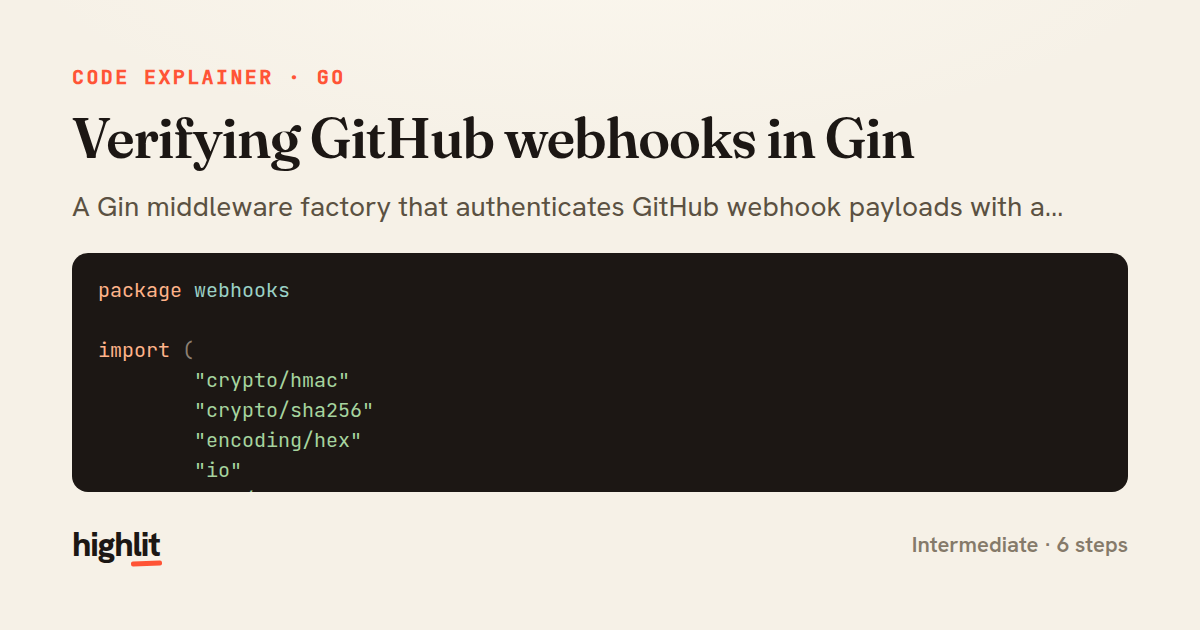
Verifying GitHub webhooks in Gin
A Gin middleware factory that authenticates GitHub webhook payloads with an HMAC-SHA256 signature before acting on them.
Explained by
highlit
1package webhooks
2
3import (
4 "crypto/hmac"
5 "crypto/sha256"
6 "encoding/hex"
7 "io"
8 "net/http"
9 "strings"
10
11 "github.com/gin-gonic/gin"
12)
13
14func GitHubHandler(secret string) gin.HandlerFunc {
15 return func(c *gin.Context) {
16 signature := c.GetHeader("X-Hub-Signature-256")
17 if !strings.HasPrefix(signature, "sha256=") {
18 c.AbortWithStatusJSON(http.StatusUnauthorized, gin.H{"error": "missing signature"})
19 return
20 }
21
22 body, err := io.ReadAll(io.LimitReader(c.Request.Body, 1<<20))
23 if err != nil {
24 c.AbortWithStatusJSON(http.StatusBadRequest, gin.H{"error": "unreadable body"})
25 return
26 }
27
28 mac := hmac.New(sha256.New, []byte(secret))
29 mac.Write(body)
30 expected := mac.Sum(nil)
31
32 provided, err := hex.DecodeString(strings.TrimPrefix(signature, "sha256="))
33 if err != nil || !hmac.Equal(expected, provided) {
34 c.AbortWithStatusJSON(http.StatusUnauthorized, gin.H{"error": "invalid signature"})
35 return
36 }
37
38 switch c.GetHeader("X-GitHub-Event") {
39 case "push":
40 c.JSON(http.StatusAccepted, gin.H{"status": "queued"})
41 default:
42 c.JSON(http.StatusOK, gin.H{"status": "ignored"})
43 }
44 }
45}
01 / 01
STEP 01
‹ swipe to step through ›
Walkthrough
Space play
←→ step
click any line
Three takeaways
- 1Returning a closure over a secret lets you configure a handler at registration time while keeping the secret out of request scope.
- 2Always cap request body reads with io.LimitReader so an attacker can't exhaust memory with a huge payload.
- 3Compare signatures with hmac.Equal, not ==, to avoid leaking information through timing differences.
Related explainers
go
package streaming

import (
	"bufio"
Streaming NDJSON logs over HTTP in Go
http-streaming
channels
select
Advanced
10 steps
python
import time
import uuid

from django.utils.deprecation import MiddlewareMixin
Attaching per-request context in Django
middleware
request lifecycle
multi-tenancy
Intermediate
7 steps
go
package api

import (
	"crypto/sha256"
ETag conditional requests in Gin
http-caching
etag
conditional-requests
Intermediate
6 steps
go
func (w *Watcher) resetDebounce(d time.Duration) {
	if !w.timer.Stop() {
		select {
		case <-w.timer.C:
Debouncing a stream of events in Go
debounce
timers
channels
Advanced
7 steps
go
package logging

import (
	"context"
Deduplicating log attributes in Go's slog
decorator-pattern
structured-logging
immutability
Intermediate
8 steps
go
package middleware

import (
	"net/http"
Per-plan export limits in Gin middleware
middleware
rate-limiting
authorization
Intermediate
7 steps
Share this explainer
Here's the card — post it anywhere.
Made with highlit — turn any snippet into a walkthrough like this in about a minute.
Explain your code
Embed this explainer
Drop the interactive walkthrough into a blog or docs. Views never cost a credit.
<iframe src="https://highlit.co/explainers/verifying-github-webhooks-in-gin-explained-go-1d35/embed?autoplay=1" width="100%" height="520" loading="lazy" style="border:0"></iframe>
Autoplay is on by default — add ?autoplay=0 to start paused.